

Mosquitoes and ticks have always been an unwelcome part of spending time outdoors, but this year there is more reason to pay attention to what may be biting.
West Nile virus activity got an unusually early start in the United States in 2026. The Centers for Disease Control and Prevention reported that by June 30, at least 48 human cases had already been reported, including 38 cases of severe neuroinvasive disease. At that point in the season, it represented the highest number of reported human infections since 2004. West Nile activity had also been detected in 23 states.
West Nile remains the leading cause of mosquito-borne disease in the contiguous United States. Most infections cause mild illness or no symptoms, but the virus can cause serious neurological disease in some people.
Ticks present another set of concerns. Lyme disease remains the best-known tick-borne illness, but public-health officials are also monitoring less common diseases, including Powassan virus and the rare Bourbon virus.
Bourbon virus was first identified in 2014 and is believed to spread through the bite of an infected tick, likely the lone star tick. Only a limited number of cases have been identified in the United States, but some patients have died during their illness. There is currently no vaccine or medicine specifically approved to prevent or treat Bourbon virus disease.
Powassan virus is also uncommon, although reported cases have been increasing in recent years. It can cause serious neurological illness, including meningitis and encephalitis, and there is currently no vaccine or specific medicine to treat it.
The growing conversation around vector-borne disease raises a practical question: How much can people do to protect themselves?
Quite a lot, according to Kurt Avery, founder of Sawyer, a company specializing in outdoor protection since 1984. Avery spoke with L.A.’s The Place about ticks, mosquitoes, repellents and some relatively simple precautions that can reduce exposure.
Protecting Yourself From Ticks and Mosquitoes: A Q&A With Kurt Avery
L.A.’s The Place: We’re seeing unusually high tick activity along with concerns about West Nile virus and emerging illnesses such as Bourbon virus. What is driving the apparent increase in vector-borne disease risk?
Kurt Avery: Ticks are certainly a growing problem due to weather, housing developments moving further into wooded areas, and a lack of natural predators that eat them or the rodents which proliferate them.
Lyme disease is by far the most common human tick-borne infection. While researchers are getting close to developing a vaccine for Lyme disease, there is currently no vaccine for Lyme or many other tick-borne infections.
Other concerns include Rocky Mountain spotted fever and Alpha-Gal syndrome, which can cause an allergy to red meat.
Three of the newer tick-borne diseases drawing attention are Bourbon virus disease, tularemia — sometimes called rabbit fever — and Powassan virus disease. Bourbon and Powassan are viral infections rather than bacterial infections, which makes prevention particularly important.
LATP: The first confirmed Bourbon virus case in New York has attracted attention because there is currently no vaccine or specific treatment. What should people understand about this virus without becoming unnecessarily alarmed?
Avery: Bourbon virus is still very rare, and that is important to keep in perspective. However, because it is viral, people need to be particularly vigilant about preventing tick bites in areas where infections have been identified.
The important takeaway isn’t to panic. It’s to have a good tick-protection plan and understand that prevention matters.
LATP: Many people associate tick bites with hiking or camping, but how much exposure actually happens closer to home, in backyards, gardens, parks and neighborhoods?
Avery: Ticks can be found anywhere you find rodents, such as squirrels, chipmunks and mice. Rodents are usually the starting point for ticks before they move to larger animals, including people.
If possible, move squirrel feeders a little farther from your home. Keep grass and outlying bushes trimmed. When hiking, try to stay on the paths and minimize your dog’s chasing critters off into the bushes.
Around your home, there are also strategies designed to target ticks associated with rodents.
The larger point is that tick prevention isn’t something people should think about only when they’re heading deep into the woods. Exposure can happen much closer to home.
LATP: With so many insect repellents available, what ingredients and formulations have the strongest evidence behind them for protection against both mosquitoes and ticks, and how should consumers choose among them?
Avery: For people, the number-one line of defense is to treat shoes and socks with permethrin before heading into tick territory.
The next level would be treating clothes with permethrin. Ticks tend to climb upward, so treated clothing provides another layer of protection. A permethrin treatment of clothing can remain effective through multiple washes, depending upon the product and its directions.
Topical repellents work on exposed skin. The important thing is to use an effective repellent properly and follow the directions on the label.
LATP: There is often confusion about DEET, picaridin and permethrin. What does each one do, how are they different, and what mistakes do people commonly make when using them?
Avery: Sawyer recommends picaridin over DEET. Both repel ticks, but picaridin will not damage certain plastics and synthetic materials the way DEET can.
Permethrin is different. It is intended for treating clothing and gear rather than being used as a topical skin repellent.
That distinction is important. People sometimes think all repellents are interchangeable, but they’re not. What you put on exposed skin and what you use to treat clothing can be two different products serving different purposes.
LATP: What should parents be doing differently when protecting children outdoors, particularly when it comes to applying repellent, treating clothing and checking for ticks afterward?
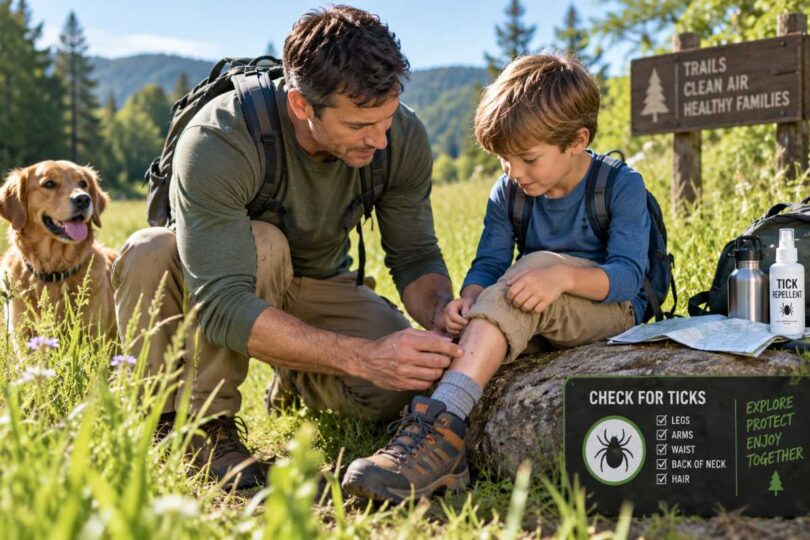
Avery: Parents should think in layers: appropriate repellent on exposed skin, treated clothing where appropriate and a careful tick check when children come back indoors.
Remember that immature ticks, or nymphs, can be extremely small — roughly the size of a poppy seed — so they’re easy to overlook.
It’s also a good idea to shower after potential tick exposure in case there are ticks that haven’t yet been noticed or attached.
LATP: If you could give families a simple five-minute routine before and after spending time outdoors this summer, what would you tell them to do to substantially reduce their risk of mosquito and tick bites?
Avery: Before heading outdoors, use an appropriate topical repellent on exposed skin and, when you’re going into tick territory, consider permethrin-treated shoes, socks and clothing.
Stay on established paths when hiking and avoid unnecessary contact with tall grass and brush.
When you return home, check yourself, your children, clothing, gear and pets carefully for ticks. Shower soon after coming indoors.
If you’re concerned that ticks may be on clothing, place the clothes in a hot dryer, provided that doing so won’t damage them.
If you find an attached tick, remove it promptly. Use fine-tipped tweezers or a tick-removal device, grasp the tick close to the skin and pull upward with steady, even pressure. Clean the bite area afterward.
The goal isn’t to stop enjoying the outdoors. It’s to make these precautions part of the routine.
More information on mosquito and tick protection is available at Sawyer.com