
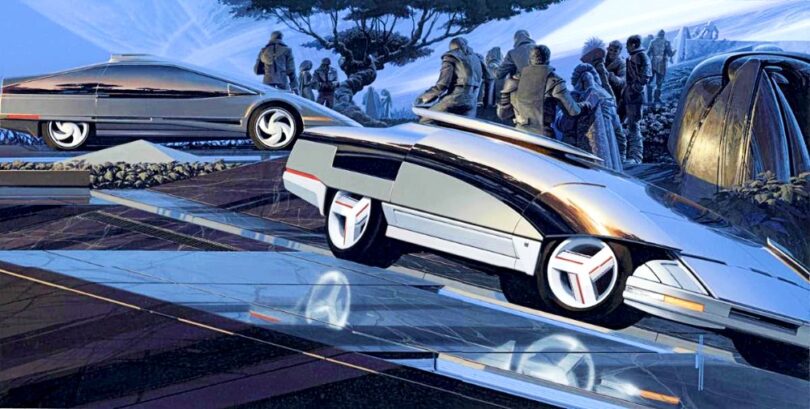

Exploring the Future as Imagined by a Master of Visual Storytelling
For generations, Syd Mead shaped the way we envision tomorrow. His intricate, futuristic worlds—marked by movement, life, and a seamless blend of technology and humanity—weren’t just flights of imagination but blueprints for what could be. Now, an exhibition titled Future Pastime, curated by William Corman and Elon Solo, will bring Mead’s legendary works to 534 W 26th St, New York City, offering a rare opportunity to explore the artistic mind that influenced everything from industrial design to Hollywood sci-fi classics.
Running from March 27 through May 21, 2025, the exhibit will be open Tuesday through Sunday, 10 AM to 6 PM, inviting visitors into a future that Mead spent a lifetime crafting.
The Man Who Built the Future Before It Arrived
Born in St. Paul, Minnesota, in 1933, Syd Mead was a small-town visionary with a boundless imagination. Raised by a Baptist minister who also happened to be an art instructor, Mead’s early life was shaped by discipline and a relentless curiosity about the world. He witnessed the impact of war, poverty, and social upheaval, yet rather than dwell in the struggles of his time, he became obsessed with designing a brighter, more dynamic future.
After serving in the U.S. Army, Mead enrolled at the Art Center School in Los Angeles, where he developed his signature fusion of classical techniques and forward-thinking design. His philosophy? Science fiction isn’t fantasy—it’s “reality ahead of schedule.” This belief fueled his lifelong mission: to visualize the future in ways that made it feel not just possible, but inevitable.

Syd Mead, Space Wheel Interior, 1979. Gouache on panel, 25 x 35 in / 63.5 x 88.9 cm.
A Career That Redefined Sci-Fi and Industrial Design
Upon graduating in 1959, Mead was recruited by Ford Motor Company’s Advanced Styling Studio, where his futuristic car concepts quickly set him apart. But it was his commission for U.S. Steel’s promotional catalogues that launched his career as a visionary beyond the automotive world. His striking, cinematic illustrations framed steel as the foundation for a sleek, high-tech future, captivating industries far beyond manufacturing.
His work soon caught the attention of major corporations including Chrysler, General Electric, Phillips, Sony, Minolta, Toyota, Dentsu, and Honda. These companies didn’t see Mead’s designs as distant fantasies—they saw them as viable, forward-thinking innovations.
Then, Hollywood took notice.
In 1979, Robert Wise enlisted Mead for Star Trek: The Motion Picture, a collaboration that would mark his entry into cinematic world-building. Soon after, Steven Lisberger brought him onto TRON (1982), and Ridley Scott recruited him for the legendary Blade Runner (1982). Mead’s visions of a neon-drenched, rain-soaked Los Angeles shaped the cyberpunk aesthetic for generations to come.
His ability to blend mechanical precision with emotional depth made him a sought-after creative force in Hollywood, leading to projects on films such as Aliens (1986) and Mission: Impossible III (2006). His meticulous gouache paintings became a bridge between conceptual art and cinematic reality, influencing how the world imagined the future—on screen and off.
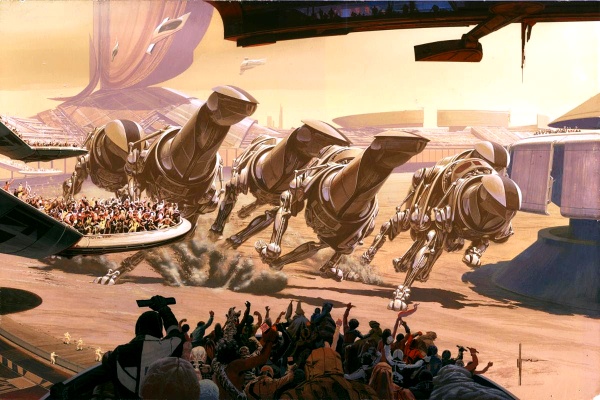
Syd Mead, Running of the Six DЯGXX, 1983. Gouache on panel, 20 x 30 in / 50.8 x 76.2 cm.
Future Pastime: A Journey Through the Mind of a Visionary
The upcoming Future Pastime exhibition will showcase some of Mead’s most celebrated works, including:
- Running of the Six DЯGXX (1983) – A breathtaking illustration of mechanical canines soaring above skyscrapers, capturing Mead’s ability to create movement and energy within his art.
- Space Wheel Interior (1979) – A gouache painting envisioning a massive, orbiting space habitat, one that remains eerily plausible even today.
Mead’s work defied the cold, sterile aesthetic of traditional sci-fi. Instead of bleak dystopias or utopian impossibilities, he painted futures that felt alive—vibrant, kinetic, and deeply human. His cities gleamed, but they were filled with people. His vehicles soared, but they had destinations. His worlds weren’t just distant dreams—they were previews of what might come next.
The Lasting Influence of Syd Mead
Mead didn’t just predict the future—he actively shaped it. The sleek automobiles, illuminated cityscapes, and innovative transportation designs he envisioned decades ago continue to influence contemporary architects, car designers, and technologists. His work remains a touchstone for designers and filmmakers who seek to create worlds that feel futuristic yet lived-in, technologically advanced yet unmistakably human.
His legacy can be seen in everything from Tesla’s Cybertruck to the evolving landscapes of today’s smart cities. Even the world’s top designers credit Mead with expanding the boundaries of what design could be.
Step Into Syd Mead’s Future
For those who have ever looked at a sci-fi film, a high-tech concept car, or a stunning futuristic cityscape and wondered, “Who imagined this first?”—the answer, more often than not, is Syd Mead.
Future Pastime is more than an art exhibition; it’s an immersive experience into the mind of the man who visualized tomorrow before the rest of us could even conceive it. This is a chance to see his blueprints for the future firsthand, to step inside a world where technology and humanity exist in harmony, and to realize that the future he imagined isn’t as far away as we once thought.
Find more about @syd_mead on Instagram
The exhibition runs from March 27 to May 21, 2025, at 534 W 26th St, NYC, offering a rare glimpse into the future that Syd Mead saw before the rest of us. futurepastime.net
We were so fortunate to have met and interviewed Syd Mead who graciosly invited us into his home in 2006. It was one of our first articles in LAsThePlace.com.
Feature photo is Syd Mead, RAYS Wheels, 1985. Gouache on panel, 20 x 30 in / 50.8 x 76.2 cm.