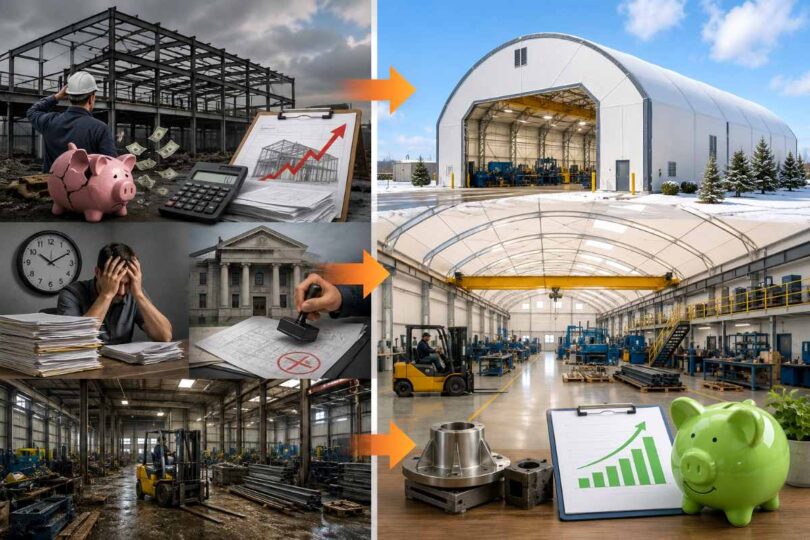

Most manufacturers assume a bigger building means a bigger loan, a longer wait, and a fight with the permit office. That assumption is wrong more often than not, and it quietly drains the expansion budget of plants that could have grown a full year earlier. The sequence is familiar. A production line outgrows its floor, a conventional steel quote lands on the desk, and the whole plan stalls because the figure looks impossible. What owners overlook is the clear span buildings MI fabricators are quietly choosing to add durable production bays without paying conventional steel prices. Three stubborn myths keep that option off the table, and every one of them carries a price tag. Take them one at a time. Each myth sounds like plain common sense, and each one falls apart the moment a real quote and a real load rating are set side by side on the same table.
Myth One Fabric Means Flimsy

Fabric sounds like a tarp thrown over poles, so buyers assume it will not survive a hard Michigan winter. Look closer. The reality is a hot-dip galvanized steel frame wrapped in tensioned architectural membrane, engineered to carry the same snow and wind loads as the block shop next door. Keeping machinery and inventory under a sealed, ventilated roof is not cosmetic, either. Virginia Cooperative Extension found that housing equipment indoors cut expected downtime from 14.7% to 7.6% and saved up to 6.7% of a machine’s purchase price each year, and a production line rewards shelter the same way a combine does. Corrosion is the other quiet win, because there is no bare steel deck sweating above a humid floor and waiting to rust through by spring. Membrane roofs also pass daylight, which trims lighting load on a first shift and keeps the floor readable without a full bank of fixtures burning overhead all day.
In practice, the plants that call have already been told fabric means temporary. What usually turns up on the site visit is a rated structure holding forklifts, welding cells, overhead cranes, and a full mezzanine without a shrug.
Myth Two Steel Is Always Cheaper
Steel gets treated as the default because everyone knows it, not because it always wins on cost. According to a March 2026 NAIOP industrial forecast, national industrial net absorption is projected to reach 345.9 million square feet in 2026, more than double the 168.3 million square feet absorbed across 2025 as demand for industrial space strengthens. Demand like that pushes conventional construction quotes up, not down. Scarce trades and booked fabricators do not hand out discounts. Budget maybe $40 a square foot for a bare steel shell. Honestly, closer to $43 once the concrete pad, anchor bolts, and permit fees land, and that is before a single machine rolls through the door.
The brochure sells strong, and the invoice tells the truth. A fabricator outside Grand Rapids priced a conventional addition last winter, watched the number climb well past the expansion budget, and shelved a planned second line for a year. When the fabric quote came back for the same footprint at a fraction of the carrying cost, the bay went up that same season and the line finally moved. That was not a fluke, and it is close to what a tight steel market does to any mid-size expansion timed against a booked order.
Myth Three Permits Take Forever
The permit myth says anything unconventional means months of delay at the county desk. Wrong again. With engineered fabric structures the opposite is usually true, because the buildings ship as pre-engineered kits with stamped drawings ready for plan review, which hands the building department exactly the sealed calculations it wants instead of a custom design drawn from a blank sheet. Lighter foundations help too. Less excavation, less concrete, and fewer inspections stand between a signed contract and a working bay, which is why a fabric package often clears review while a bespoke steel design is still waiting on its structural stamp. The kit arrives with the engineering already finished, so a reviewer checks a stamped package instead of chasing a designer for missing calculations, and that alone can shave real days off the front of a project. Speed is money once a customer order is already booked against the new capacity. Every week on the calendar is another week of interest on the construction loan.
Durable Space Costs Less Than Assumed
Run the numbers on the Michigan shop that started this piece, a 20,000 square foot production bay. At a representative $25 a square foot for a fabric clear-span shell the structure comes to $500,000, while the same footprint in conventional steel at $40 a foot runs to $800,000 before a single option is added. Even a pole barn near $30 a foot lands in between, though without the sealed, insulated envelope a fabrication floor actually needs. That $300,000 gap is not rounding error. It buys a press brake, or funds a second shift, or simply keeps the construction loan small enough that the expansion pays for itself sooner. For an operator counting real dollars per square foot, clear span buildings MI plants can raise in a single season quietly change what growth is even possible. The durable choice was the affordable one the entire time, and the myths were just louder than the math.