
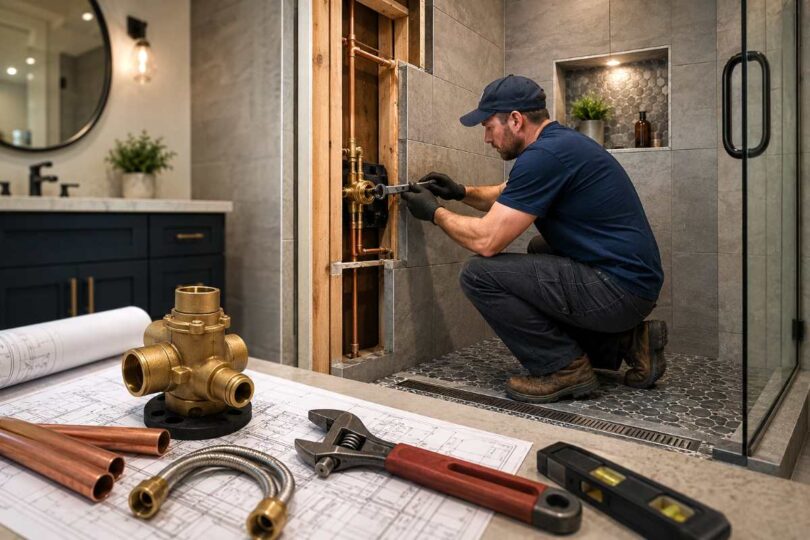

A skilled handyman can hang tile and set a shower pan, or so the sales pitch goes. That belief is exactly why the local plumbers Sylvania OH homeowners trust get called back to redo a botched valve a year later. A licensed plumber has to own the valve and the waterproofing on a custom shower, or the job fails from the inside out. On a five-figure master bath, that is not a risk worth taking to save a few hundred dollars up front. The finish can look perfect and still be hiding a mistake that costs more than the original tile.
Where Custom Shower Plumbing Goes Wrong
Two systems decide whether a custom shower lasts: the mixing valve buried in the wall and the waterproofing under the tile. The case we see most often is a pan that was never flood tested, so the leak hides for months and rots the framing behind it. A handyman can make the surface look flawless and still miss both, because neither one is visible once the tile is up. That is the trap of judging this work by the grout lines. By the time a stain shows on the ceiling below, the repair is structural, not cosmetic.
Example scenario: handyman shortcut vs licensed plumber on a custom shower (typical cost ranges)
| Line item | Handyman shortcut | Licensed plumber |
| Shower valve and rough-in | Basic valve swap, about $225 to $575, pressure-balance often skipped | Code pressure-balance valve set in the rough-in, about $400 to $800 |
| Waterproofing membrane | Paint-on only or skipped, about $0.75 to $1.50 per sq ft in material | Bonded sheet membrane plus a flood test, about $1.50 to $2.50 per sq ft material and $3 to $6 per sq ft labor |
| Permit and inspection | None pulled ($0) | Permit and inspection, about $50 to $500 |
| Callback or redo risk | Tear-out and mold repair if it leaks, often several thousand dollars | Warranty-backed; a shower-pan replacement runs $530 to $2,700 only if ever needed |
Getting the plumbing right is not only about stopping leaks. In March 2026, a national plumbing standards group rolled out a water campaign with a blunt message for owners. Simple fixture upgrades are the single biggest change you can make, IAPMO notes, saving 250 to 1,500 gallons per home a year and about $5,000 over a house when the pipes are right-sized. Chase that thread far enough and you land in utility rebates and greywater codes, which is a different article. Back to the shower itself. The same licensed hands that size those supply lines are the ones who keep a custom pan from ever leaking.
Waterproofing Is Not a Handyman Job
Waterproofing a shower is a full system, not a coat of paint. A proper build bonds a sheet membrane across the walls and the pan. Then it gets proven with what the trades call a flood test, meaning you plug the drain, fill the pan, and wait overnight to see if it drips. Job after job, the redo starts because someone rolled on a liquid membrane too thin, or skipped the test to stay on schedule. The pan also needs a pre-slope under the liner so water actually reaches the weep holes in the drain. Miss that and the base stays wet even when the surface looks bone dry.
Skip the membrane and you are betting a $26,000 remodel on a bead of caulk.
Handyman Versus Licensed Plumber by the Numbers
The best local plumbers Sylvania OH homeowners can hire will list a permit and a flood test as line items, not surprise upsells at the end. The savings add up too: Penn State Extension prices a low-flow faucet aerator at $0.50 to $3 and credits a low-flow showerhead with about 47 kWh saved a year. A pro sizes the supply lines and sets a pressure-balance valve so the water does not scald you when a toilet flushes down the hall. Those are code items, and a city inspector signs off on each one before the walls close. A handyman rarely pulls the permit that would trigger that inspection at all.
A Real Redo Cost Walked Step by Step
Walk the redo on a Sylvania spa bath that a handyman roughed in. Say the original job ran $26,000 and the valve shortcut shaved $500 off the bid up front. When the pan let go in year two, the tear-out ran $2,400 and mold remediation another $1,900. A bonded membrane with a proper flood test added $3,100, and re-tiling the enclosure ran $6,800. That comes to about $14,200 to fix what a permit and a licensed rough-in would have covered the first time.
Hire It Right the First Time
Hiring right is cheaper than hiring twice, and on a custom shower that gap is measured in thousands, not hundreds. Ask any bidder to name the membrane they use and the valve they set. Confirm a permit is pulled and a flood test is run before the tile goes on. A contractor who treats those steps as standard is the one whose work survives the first hard winter. Weigh that against the handyman quote that looks cheaper only until the ceiling stains. The shower you actually want is the one you never have to think about again.