

Ad spend does not win injury cases. A paper trail of settlements does. Anyone comparing South Jersey firms after a serious crash should weigh three things above all, tenure, in-house medical review, and a documented settlement record. That is why the search for the best injury lawyer Washington Township NJ residents can trust starts with evidence instead of the biggest billboard. The loudest advertiser is almost never the same firm as the one with the longest record of results. This guide walks through six questions that pull those two apart.
Ad Volume Says Nothing About Results
Billboards, radio spots, and top-of-search ads measure one thing, a marketing budget. They say nothing about how a firm performs once a claim lands on an adjuster’s desk. The stakes in an injury case are large and well documented. According to NHTSA, motor vehicle crashes imposed about $340 billion in economic costs nationwide in 2019. That works out to roughly $1,035 for every person in the country, spread across more than 4.5 million nonfatal injuries. Those are the real losses a strong firm has to recover, dollar by dollar, long after an ad campaign ends.
Advertising reaches potential clients, not the adjuster who decides your payout.
Years in Practice Predict Case Handling
Tenure is not a vanity metric. A firm that has handled injury claims for decades has seen the same insurer tactics again and again, the same lowball first offers, the same disputed-liability arguments. That accumulated experience is what lets a seasoned lawyer value a claim quickly and reject a weak offer without blinking. A newer practice may be perfectly capable, but it is still building instincts that only volume provides. When you compare firms across South Jersey, ask how many years they have handled your specific type of case. Do not settle for how long the office has kept its doors open. The two numbers are rarely the same.
There is a simple test that cuts through the marketing. Ask a firm to describe how it handled a case like yours, from the first call to the final check. A practice with real tenure answers in specifics, the timeline, the obstacles, and the number it recovered. A thinly staffed office tends to answer in generalities instead. The amount of concrete detail in that answer is a reliable read on real experience.
In-House Medical Review Is Rare
Most personal injury firms send medical records out to an outside nurse consultant, or skip a close review altogether. A practice with a physician on staff who actually reads the imaging and the treatment notes can catch an undervalued injury before the demand letter ever goes out. That matters because the gap between a sprain and a permanent impairment is often buried in a radiology report the insurer is betting nobody reads carefully. Ask any firm whether a medical professional reviews your file internally, and exactly who that person is. What usually turns up is a no, which is precisely why the exception is worth hunting for. An in-house medical read can move a claim’s value by a wide margin, and it stays one of the clearest ways to tell a serious firm from an advertising-first volume mill that never opens the imaging.
Settlement Data Reveals Firm Strength
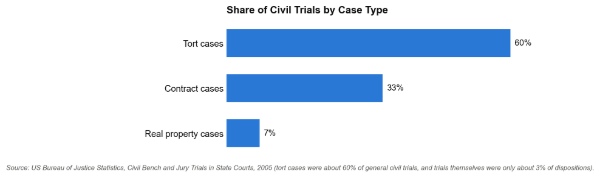
Here is the reality of injury litigation. In practice, the overwhelming majority of cases never reach a courtroom, so a firm’s real skill shows up in what it negotiates, not in rare trial verdicts. The chart above puts the trial picture in proportion. Tort cases, the category that covers crash and injury claims, make up the largest slice of the civil disputes that go to trial, while the vast majority of every other case settles quietly well before a judge or jury is ever involved. A documented settlement history therefore tells you far more than a single trial-win headline. The dollars in play keep climbing, too. Insurify pegged the national average for full-coverage car insurance at $186 a month in June 2026. That is a fair proxy for how costly every collision has become to insure and to resolve. When the numbers run that high, the firm that can show what it has recovered walks in with real leverage.
Questions That Reveal a Track Record
You do not need a law degree to test a firm. A handful of direct questions separates the shops with a genuine history from those relying on ad spend (and yes, the good ones answer these without flinching). Ask them before you sign anything, and listen for specific numbers instead of polished slogans.
- How many cases like mine have you taken to a settlement or a verdict, and what were the results? A good answer names real figures, not adjectives.
- Who on your staff reviews my medical records, and is a physician involved? The strongest answer names an on-staff doctor.
- What is your contingency fee, and do I owe any costs if the case does not succeed? A clear answer states the percentage and the cost policy up front.
- How long have you specifically handled this exact type of injury claim? Years on this claim type matter more than years in business.
You can also verify part of the record yourself. The New Jersey Courts online docket portal, NJCourts.gov, lets anyone look up civil case filings for free. A firm’s claim of deep courtroom experience is simple to spot-check there. When a lawyer hesitates to point you toward public records, it is fair to treat that hesitation as its own answer.
Choose on Evidence Not on Billboards
Strip away the jingles and the courthouse-steps photography, and the decision gets much simpler. Choosing the best injury lawyer Washington Township NJ has to offer comes down to three things you can verify yourself, the years a firm has handled your kind of case, whether a medical professional actually reads your file, and a settlement record the firm will put in front of you. A billboard writes a check the caseload then has to cash, and only one of those two ever holds up under an adjuster’s pressure. Pick the firm whose results you can read for yourself, not the one paying for the largest ad budget.