


A five-star rental sells the view. A five-star rental sells the quiet. A five-star rental sells the promise that nothing here will need your attention. One line of ants marching across the lanai breaks all three promises at once, and the guest reaches for their phone. That is why owners of upscale Ft Myers short-term rentals increasingly keep pest control companies in Ft Myers FL on a standing schedule, treating insects as a fixed cost of doing business rather than a fire to put out after a complaint has already landed. A booked-solid summer and a string of quiet cancellations often come down to that single decision.
Guests Notice Bugs Before Anything Else
Walk a guest through the door and their eyes run a quick audit before they ever unpack. Clean counters and fresh linens register first, and so does any movement in the corners. A cockroach on the kitchen tile at midnight erases the sunset photos they took six hours earlier. The case we see most often is a rental that photographs beautifully and still earns a one-star review over a single silverfish in the bathroom sink. Guests do not grade insects on a curve. Bugs don’t check the reservation calendar, and they do not care what the nightly rate is.
Insect Activity Follows A Predictable Seasonal Curve
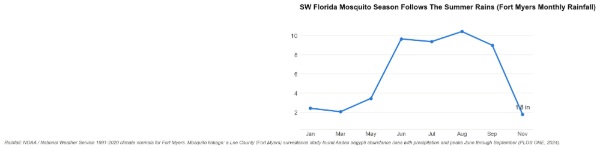
Southwest Florida runs on two seasons, wet and dry, and the insects keep the same calendar. Mosquito pressure climbs with the summer rains and holds from roughly June through September, which is exactly when the region books its highest nightly rates. The chart above tells that story in one line. Florida’s mosquito control districts happen to be some of the oldest public-health programs in the country, a few of them dating back to the 1920s. That history is a tangent for another day. What matters for a rental owner is that the curve spikes precisely when the calendar is fullest.
The pattern is not subtle. Florida logged 431 travel-associated dengue cases in 2025 along with 62 locally acquired ones, according to the state health department’s February 2026 arbovirus surveillance report. That makes mosquitoes here a public-health matter and not merely a comfort issue, and guests who follow the news arrive already primed to notice a bite at dusk.
A one-star review tends to land during this same window, and the timing is what makes it so costly. Harvard Business School researcher Michael Luca found that a single extra star on an online rating drives a 5 to 9 percent jump in revenue, and the effect runs strongest for independent operators like a one-owner rental. Run that finding in reverse and a lost star during your busiest weeks quietly bleeds real money for months. That is the stretch when hiring pest control companies in Ft Myers FL on a standing schedule pays for itself several times over.
A Standing Program Protects The Calendar
You cannot spray your way out of this in a single visit, and the reason is biology. The American Mosquito Control Association notes that even weak-flying Culex mosquitoes have turned up as far as two miles from where they hatched, while Aedes species range many miles farther. Treating only your own hedge does little when the next brood drifts in from a canal a few streets over. A standing program answers that with what the trade calls a barrier treatment, meaning a residual perimeter spray that keeps knocking down insects for weeks after the technician packs up the truck. Repeat it on a schedule through the wet months and the property stays ahead of each new hatch instead of forever chasing the last one.
The arithmetic makes the case better than any pitch. Say the rental books at $480 a night through the summer and one insect review knocks the listing out of the top search results for a stretch. If that costs you twelve booked nights across June, July and August, twelve times $480 comes to $5,760 in lost revenue. A standing insect program running about $115 a visit, six visits a year, totals $690. So the real choice is roughly $690 in prevention set against $5,760 in exposure, and that figure still ignores the slow drip of a rating that sits a notch lower for the rest of the year.
None of this ever shows up in the listing photos, which is exactly the point. A rental that never generates a bug complaint simply keeps earning its five-star reviews and its premium rate, quarter after quarter. The owners who treat insect control as a fixed line item are not spending more than the ones who wait for a crisis. They are spending it on a schedule, before a guest ever notices, and their calendar stays full because of it.