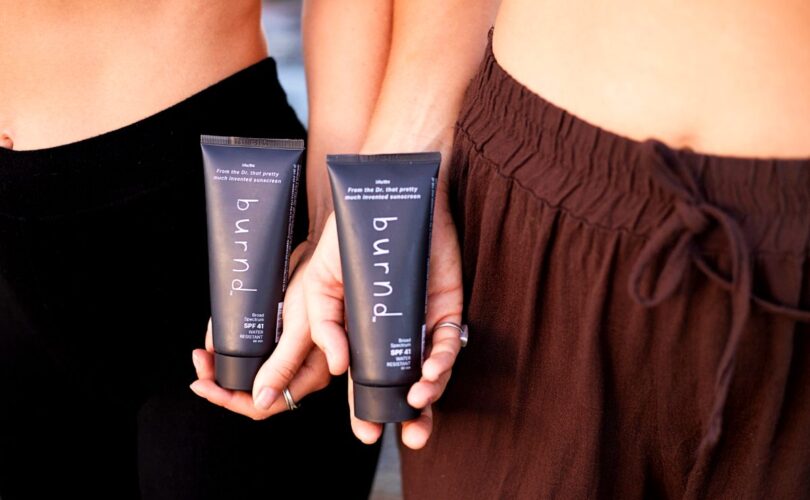

Sunscreen has become one of the most crowded and confusing categories in skincare. Shelves are packed with products promising “clean,” “reef-safe,” “natural,” or “non-toxic” formulas, while consumers are left trying to separate meaningful innovation from marketing language. New brand burnd enters that conversation with a different approach: build a sunscreen people will actually want to wear every day.
The company’s newly launched burnd SPF 41 was created by Dr. Mark Mitchnick, the pediatrician behind transparent zinc oxide technology Z-COTE®, alongside his son Malachy Mitchnick and former birddogs CMO John Barnett. Rather than focusing on trends or influencer-driven talking points, the team reportedly started with a simple question: what would the best sunscreen actually need to do?

For burnd, that answer centered around performance. The formula was designed for real outdoor use, including sports, swimming, heat, sweat, and long stretches of sun exposure. At the same time, the brand wanted the texture and feel to resemble high-end skincare rather than the thick, greasy sunscreens many people avoid wearing consistently.
burnd SPF 41 uses water-in-oil reverse emulsion technology combined with transparent zinc oxide and advanced silicones to create a flexible film that adheres evenly to the skin. According to the company, the sunscreen is highly water resistant, non-greasy, and designed not to run into the eyes when exposed to sweat or water.
That last point may sound minor until anyone remembers trying to apply sunscreen to kids moments before they sprint toward a pool or beach. One of the biggest complaints parents have with SPF products is the stinging and irritation caused when formulas begin melting into the eyes. burnd’s development team says preventing that issue became part of the engineering process from the start.
The sunscreen is also designed to dry down transparently without leaving behind the heavy white cast often associated with mineral SPF products. The goal was broad-spectrum UVA and UVB protection that feels breathable enough for daily wear but durable enough for extended outdoor activity.
What makes the launch interesting is the background of the people behind it. The development process reportedly included pediatricians, dermatologists, toxicologists, biomedical engineers, and other specialists who work directly in formulation science rather than simply participating in online skincare discourse.
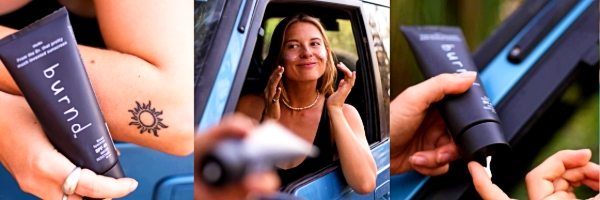
As conversations around sunscreen safety, ingredient transparency, and misinformation continue to dominate social media, burnd appears positioned to lean into a more science-based discussion. We spoke with Dr. Mitchnick on broader topics surrounding SPF safety, fear-based skincare marketing, and the growing gap between internet trends and actual formulation expertise.
LAsThePlace: What was the exact moment you realized the sunscreen category needed a complete reset instead of another variation?
Dr. Mitchnick: The exact moment was really a combination of a few things, but it started with frustration.
In late 2024, I was living in Costa Rica during a run of swell that lit up the beach breaks around Nosara. I ended up on a bit of a surf bender, and by the third day I had completely torched myself – despite doing everything right. I was layering sunscreen constantly: cream in the morning, reapplying before heading out, and covering my face and head (I’m bald) with thick tinted zinc. I tried everything – surf shop brands, higher-end “luxury” products I ordered online. I reapplied, I was diligent, and the result was still sunburn and acne. At a certain point I couldn’t even surf because I was so burned.
So I started looking for something better. I grew up with a dad who invented transparent zinc oxide and built one of the foundational technologies used in modern sunscreen, so I had a baseline understanding. But as I started researching, I realized none of the brands were actually helping me solve the problem. Everything was surface level – ingredient lists, marketing claims, vague education. I went down the reef safety rabbit hole, tried to understand formulations, tried to compare products, and got nowhere. Even with my background, I couldn’t tell what was actually good versus not. No one was explaining what really mattered.
At the same time, I knew a real solution existed – because I had used it. When I was a kid, my dad had made a sunscreen in small batches through his company that he originally started to commercialize transparent zinc oxide. I could put it on once in the morning and surf for hours without burning. It didn’t give me acne, it felt good on my skin, it didn’t leave a white cast, and it washed off cleanly. But after his company was sold, he stopped making it.
One night around that time, I was at dinner with friends and sunscreen came up. Everyone at the table was in the same position – burned, frustrated, and no better informed despite genuinely trying to figure it out.
So I called my dad. I told him I couldn’t find anything that performed like what he used to make, and asked why no one had rebuilt it. That conversation led directly to burnd.
To me, it felt simple. No one was making sunscreen that actually solved the problem, and no one was communicating in a way that helped people make real decisions. The industry had drifted into a mix of underperforming products and increasingly confusing, fear-driven messaging. The opportunity was to reset both – build a product that actually works the way it should, and talk to people like they actually want to be talked to.
LATP: When you were developing this, what frustrated you most about the sunscreens you personally used?
Dr. Mitchnick: What frustrated me most was pretty simple.
First, the products didn’t actually work. I was doing everything right – applying, reapplying, trying different brands – and I was still getting burned and breaking out. That’s a fundamental failure for something whose entire job is protection.
Second, the information I was getting from brands wasn’t helpful. Most of it was rooted in fear rather than education – a lot of extreme messaging about how dangerous the sun is, but very little that actually helped me understand how to choose the right product or what really mattered in a formulation.
And third, I knew enough to realize that a lot of what was being said – both in terms of performance and what was actually in the formulas – didn’t fully add up. You see “all mineral” sunscreens claiming really high SPFs with relatively low percentages of zinc oxide, which from a formulation standpoint doesn’t make much sense unless something else is going on. In many cases, that “something else” is the use of SPF boosters like butyloctyl salicylate – ingredients that are chemically very similar to organic UV filters but aren’t regulated the same way. They have legitimate uses, but when they’re used to artificially inflate SPF in products marketed as purely mineral, it starts to feel misleading.
And that’s really where the trust breaks. If I know that’s happening and it’s not being clearly communicated, then how am I supposed to trust anything else the brand is telling me about their product? At that point, it’s not just a performance issue – it’s a credibility issue.
LATP: What makes SPF 41 an effective level of protection for everyday and high-exposure use
Dr. Mitchnick: There’s nothing inherently magical about SPF 41 – it’s simply what our formula tested at, so that’s what we put on the label. And we like the name. At that level, you’re blocking roughly 97% of the UVB rays that cause sunburn, which by any reasonable standard is a very high level of protection.
But the real driver of effectiveness with sunscreen isn’t just the number – it’s whether people actually use it correctly. Most people don’t apply enough, and they don’t reapply consistently. The biggest reason for that is simple: most sunscreens just aren’t pleasant to use.
That’s really where we focused. SPF 41 is effective not just because of the number, but because it’s a genuinely elegant formula that people want to put on. It goes on clear with no white cast, doesn’t clog pores or cause acne, and feels more like a high-end moisturizer than a traditional sunscreen.
At the same time, it performs as hard as science will allow – it’s highly water resistant, sweat resistant, and built to hold up in real conditions. You’re not trading feel for function, or function for feel. You’re getting both.
That balance comes from how we built the formula. We use a reverse emulsion system that allows us to combine transparent zinc oxide with organic UV filters, along with silicones and higher-end skincare ingredients like vitamins C and E. The result is a sunscreen that delivers serious, broad-spectrum protection, but in a format that people will actually use the way it’s intended.
At the end of the day, a sunscreen you don’t use has an SPF of zero. The reason SPF 41 works so well is because you don’t have to choose between something that feels good and something that actually protects you.
LATP: How did your background in transparent zinc oxide shape the way this formula behaves on skin today?
Dr. Mitchnick: Having invented transparent zinc oxide, we have a very clear understanding of how to get the most out of it – and just as importantly, what it can’t do on its own.
That matters because zinc oxide is an excellent UV filter, but it has real limitations, especially when it comes to aesthetics and feel. If you don’t fully understand those tradeoffs, you either end up with something that protects well but feels terrible, or something that feels good but doesn’t perform the way it should.
The key is knowing how to build around it. That means selecting the right complementary ingredients and using the right formulation techniques to bridge that gap – so you end up with something that works as well as it feels.
A big part of that comes down to formulation. Over 70% of a sunscreen is made up of so-called “inactive” ingredients, but those are actually what drive the texture, water resistance, finish, and overall experience of the product. They’re what determine whether someone will actually use it correctly and consistently.
Because we understand both the strengths and the limitations of transparent zinc oxide, we’re able to formulate it in a way that delivers strong, broad-spectrum protection while still feeling clean, lightweight, and easy to wear. And that balance – performance and experience – is really what makes the difference.
LATP: How does transparent zinc oxide differ from traditional mineral sunscreen ingredients
Dr. Mitchnick: There are two primary mineral UV filters – zinc oxide and titanium dioxide. What people call “white” versus “transparent” versions of these ingredients isn’t a chemical difference, it’s a physical one – it comes down to particle size.
The smaller the zinc oxide particles, the more transparent the formula appears on skin. And somewhat counterintuitively, smaller particles can also deliver higher SPF performance because they disperse more evenly.
A simple way to think about it: imagine a pool table. If you place one large chunk of zinc oxide on it – say the size of a basketball – most of the table is still exposed. But if you grind that same chunk into a fine powder, you can spread it out and cover the entire surface in a thin, even layer. That’s essentially what’s happening in a sunscreen formulation.
LATP: Was there a point during development where you almost compromised on performance or feel, and chose not to?
Dr. Mitchnick: No. When you develop health care products for a living, which we have for 30 years, you start with performance, which is defined as what is it you want the product to do. For burnd SPF 41 performance meant a higher SPF, highly water and sweat resistant, and long lasting yet moisturizing and elegant. If we couldn’t do that, there was no differentiation and no reason for people to try burnd … so, no reason to start a company.
LATP: What does a “failure” look like to you when testing sunscreen in real-world conditions?
Dr. Mitchnick: Not getting one of our performance goals is the broad answer. Obviously, people getting sunburned despite the high SPF is big fail. For the SPF 41 where we designed it to be suitable for anything but durable enough for strenuous outdoor activity including watersports, a failure is it not staying on when it matters. Failure here can show up as sunburn but also it running into your eyes or staining your clothes. And getting back to correct use being a big driver of success, failure to us was people not using enough or any because its unpleasant.
LATP: How did you approach making something that both adults and kids would actually tolerate wearing all day?
Dr. Mitchnick: Its really the same. Why on earth would you put something on yourself that you didn’t think was good enough for your kid. Why would you expect your kid to look forward to some greasy heavy lotion that you would never use? A really great product is great for kids and adults.
LATP: What detail in this formula would most people overlook but you know makes a huge difference?
Dr. Mitchnick: It’s the type of emulsion, the way we mix the oil and the water in the formulation. Most products mix little oil droplets into water, think salad dressing. We do the opposite, we mix water droplets into the oil. Its called a reverse emulsion. We didn’t invent this technology but we are really good at using it, especially when it comes to sunscreens. This matters because it’s the primary driver in what allows our sunscreen to feel good while still being highly protective.
LATP: What misconceptions about mineral sunscreen still bother you the most?
Dr. Mitchnick: That they work by reflecting UV radiation. They actually work the same way the organic, “chemical”, filters do. They absorb UV radiation, not reflect it.
That they are safer than the organic screens. When people say this, it implies the organic screens are not safe. All of the legit science says the commonly used organic sunscreens are safe. So, sure the mineral sunscreens are safe but so are the organic filters.
That they are “natural”. No one digs zinc oxide or titanium dioxide out of the ground. They are made in very high-tech factories. That’s not a negative, its just that they are not “natural”
That they are biodegradable. They are literally components of rocks and they don’t really break down, especially titanium dioxide. Ironically, the organic (chemical) sunscreens are biodegradable.
None of this is to say zinc oxide is not great. It is. Its just not the total answer to our sunscreen needs.
LATP: When you say “best sunscreen,” what standard are you holding yourself to behind the scenes?
Dr. Mitchnick: The “Performance” standards above. Our goal was to create a really elegant, moisturizing, super water resistant, high SPF product that was a joy to use. It has to be something we use ourselves because it’s the best, not just because its ours.
burnd is about education. We want people to leave our web page better informed than when they got there. We include this here because we think that the best sunscreens or products in general are ones that give you (the consumer) the information you need to make a decision, not just scare you into buying ours.
Along the same lines, transparency on our website and our marketing. If the only way I can convince you to try our product is by telling you that if you use something else you are going to harm yourself, that’s a failure.
LATP: What surprised you most once people outside your team started using it?
Dr. Mitchnick: How passionate people are about the product and the category. We get a lot of positive feedback but some of the most important info comes from the consumers that are questioning the product. For example, reef safety comes up a lot. Its very common for us to get someone asking us about octinoxate and reef safety and why would we use it. What is pleasantly surprising is that when we explain the science and our approach to reef safety, virtually everyone we who has contacted us changes their mind and gives the product a shot.
LATP: If someone only uses sunscreen occasionally, what would you want them to understand after trying this?
Dr. Mitchnick: Using sunscreen occasionally is better than not at all, but it’s also not ideal. Sun damage is cumulative so if you want to prevent it, wear a hat, appropriate clothing a good broad-spectrum sunscreen. Hopefully, after trying burnd, you will see that sunscreen can not only be nice to wear but easy and you will wear it more often.
LATP: Why does water-in-oil reverse emulsion technology improve performance in heat and water?
Dr. Mitchnick: An emulsion is formulation type where little droplets of one phase (oil or water) are inside another phase (water or oil). To make this stable you need “emulsifiers”, compounds that wrap around the droplets (the internal phase) and coat them with something that is compatible with the external or other phase. Think salad dressing you make at home with just oil and vinegar that separates once you stop shaking and salad dressing you buy. The reason the one you buy does not separate is that it has emulsifiers. Normal emulsions use emulsifiers that help the susncreen dissolve off your skin into sweat or the water. In a reverse emulsion, the emulsifiers tend to do the opposite, and don’t work against you.
LATP: What does “reef-safe” actually mean in real-world use?
Dr. Mitchnick: As a legal or scientific matter, pretty much nothing. No one argues that we need to be all in when it comes to taking care of our environment, including the ocean and reefs. But, there is no legal definition of reef safety. There are a few definitions set by various organizations and some state level governments, but they specify what they think is not safe, not what is. The reasoning these organizations used to come up with these standards is based on good science but not so good interpretation of that science.
Marketers have seized on this and turned this really legit idea of environmental safety into click bait. At burnd, our belief is that the reef is best left alone with no exposure to the stuff we bring along when we go in the water. Our formulations are designed to stay on you and out of the water and that’s how we approach it – focus on real world formulation performance, not buzz words. Its not easy to do this a brand because we actually use an ingredient some point to as not being reef safe, octinoxate. Why do we do this? Because it allows us to make high SPF formulations that are incredibly water resistant, they stay on you and out of the water. We choose to follow the science.
LATP: How important is texture and feel in whether people consistently use sunscreen?
Dr. Mitchnick: It’s the most important thing. As a physician I can tell you we humans are not very compliant when it comes to our health. Using prescription medicines as an example, its estimated that 125,000 people a year in the US alone die from not taking their medication as directed. It accounts for 10% of hospitalizations and about $200 billion in additional costs. So, if using a sunscreen is unpleasant, its obviously going to have a major impact on use. This is why elegance is always at the top of our performance requirements.
LATP: Can a sunscreen realistically replace a daily moisturizer in a skincare routine?
Dr. Mitchnick: Technically yes. Sunscreens can be formulated with excellent moisturizing ingredients. Our SPF 41 is a great example as is our tinted daily product that will out later this year. But, should they? That’s a different questions. burnds view is that if you’re only going out in the earlyish am and in the evening, you probably don’t need a sunscreen and a simple high quality moisturizer should do it. We don’t buy into the 24/7 sun protection idea. Also, different moisturizers work in different ways. For example, our Restore product works by replacing the lost lipids (fats) in your skin which repairs the moisture barrier. Our SPF 41 product Octinoxate ingredients that keep you from losing too much moisture. So both effective but complimentary ways if keeping your skin from drying out.
LATP: What should people look for when choosing sunscreen for kids versus adults?
Dr. Mitchnick: There really should be no difference. If its good enough for junior it should be good enough for you and you should not use something you think is bad for your kid. I would instead look at what is the right sunscreen for the situation. If me or my kid is going in the water, then I want one made for that. If Im just walkign around the city all day and not even seating, then I don’t need that. If there is a water resistant product that feels great then no harm in using it but its not required. For burnd, this again comes back to requirements. We don’t think skin care should be complicated, one product for that and another for this. If you build both performance and elegance into each product from the get-go then you are giving consumers flexibility and making their life easier instead of more complicated.
LATP: How often should sunscreen be reapplied during swimming or heavy sweating?
Dr. Mitchnick: The FDA is very clear on this. If you do the testing required, you can label your sunscreen as “water resistant” for 40 or 80 minutes depending of how you test it. The instruction language on the label has to say “Reapply immediately after swimming, sweating, or toweling off”. This is true even if a sunscreen lasts longer. So, while we built SPF 41 to really stay put, our instructions read exactly the same as every other product as is required.
LATP: What are the most common reasons sunscreen fails during outdoor activity?
Dr. Mitchnick: Poor formulations that pass the lab tests for SPF and water resistance but really are not up to challenging real world conditions.
Under application. In general people don’t apply enough sunscreen. And, half the amount of an SPF 30 is not an SPF 15, its something considerably less. Again, we are back to compliance. As a brand, its our job, our responsibility, to make products that perform as used, not as tested under ideal conditions. The way we can make this happen is to make products that feel great, aren’t a chore to use.
Are not put on soon enough. Roughly speaking, an SPF 30 means that if you would burn in 10 minutes and keep an SPF on you used properly you have 300 minutes before you get enough UV to cause a burn. Now, if you go out under full sun and wait 5 minutes before you apply sunscreen, then you have used 5 of your 10 minutes and now you only have 150 minutes of protection (5 x 30). So that 5 minutes cost you 2.5 hours! This is why the label says apply before you go outside.
LATP: How has sunscreen formulation evolved in response to modern lifestyles?
Dr. Mitchnick: Not enough.
There are better formulation technologies available today, but the sunscreen industry has been slow to adopt them. It’s an incredibly competitive category, and real innovation is expensive. Even small formulation changes require starting over with testing, which takes time and serious capital if you do it properly.
Instead of investing in better or different products, most companies have focused on evolving their marketing. They’ve found new ways to describe formulas, and in many cases leaned on selective or misinterpreted studies to cast doubt on other approaches. In other words, they’ve spent more time trying to discredit competing products than actually proving their own.
You can see this clearly in the rise of Korean beauty. There’s a perception that Korean sunscreens are inherently better because of some unique access to ingredients or technology, but that’s not really the case. They’re working with largely the same toolbox. The difference is that they’ve consistently invested the time and effort into making more elegant, better-feeling products. Instead of following that lead and improving their own formulations, many brands have simply latched onto the idea of Korean beauty as a marketing angle – using it to sell, rather than actually making their products better.
That’s really the core of what frustrates me. Rather than pushing the science forward and building genuinely better sunscreens, a lot of the industry has defaulted to messaging.
To be fair, there has been some real progress. One of the more meaningful developments in recent years is the introduction of newer UV filters like Bis-Ethylhexyloxyphenol Methoxyphenyl Triazine (BEMT). It’s a highly effective, broad-spectrum filter that’s widely used globally and expected to be approved in the U.S. in the near future. It’s something we’re excited about and plan to incorporate into future products, including a sunscreen stick once it becomes available here.
But the bigger point is this – better sunscreen isn’t dependent on new ingredients. We already have the tools, and we’ve had them for decades. Making a bad sunscreen at this point isn’t about lack of access – it’s about choices.
What is changing is the consumer. People are more informed, more curious, and more willing to understand what they’re putting on their skin than ever before. And that shift is starting to force the industry to move beyond just messaging and actually deliver better products.
With Skin Cancer Awareness Month approaching and summer travel season beginning, burnd enters the market at a time when consumers are paying closer attention not just to whether they wear sunscreen, but whether the experience of using it finally feels good enough to become part of everyday life.