
Getting self tan right on very fair skin is less about the product itself and more about how you control it. The margin for error is smaller, which means technique, dilution, and timing matter more than simply picking a shade off the label. Choosing the best self tanner for pale skin is really about finding something you can adjust, not something that locks you into one result.
What tends to go wrong on pale skin is not the concept of tanning, but the lack of flexibility. A formula that develops too quickly or too deeply leaves no room to correct. Customization is what keeps the result believable, and that comes down to how you layer, mix, and space out your applications.
Use Dilution Instead of a “Light Shade”
Many people with fair skin default to the lightest version of a product, assuming that will solve the problem. In practice, that often still develops darker than expected or turns uneven because it is applied straight onto the skin. A more reliable approach is dilution.
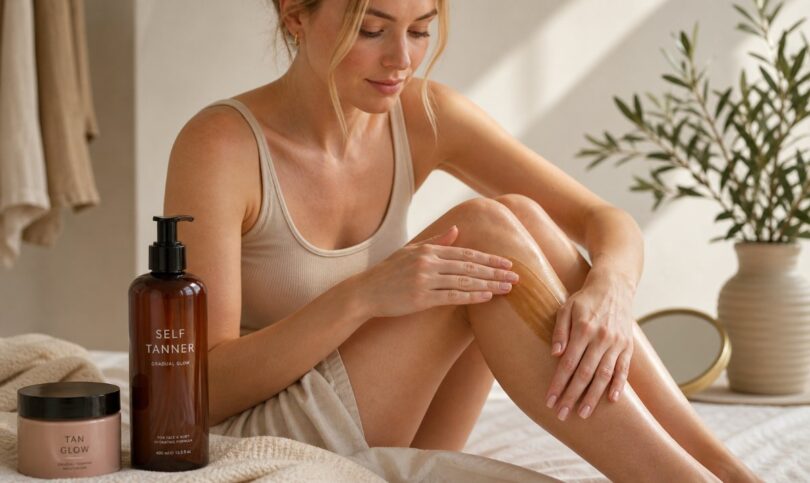
Mixing tanning drops into your moisturizer gives you control over how much pigment actually touches your skin. You are not relying on the formula alone to be subtle. You are actively softening it. This makes the result easier to adjust and far less likely to grab unevenly in dry areas.
It also allows you to use the same product differently depending on the situation. A lighter mix works for the face or daytime wear, while a slightly stronger mix can be used on the body when you want more warmth.
Focus on Where Color Builds, Not Just How Much
On pale skin, placement matters just as much as intensity. Color does not need to be completely uniform to look natural. In fact, it usually should not be. Areas like the center of the arms and legs can carry slightly more depth, while joints and edges should stay softer. If everything develops at the same intensity, the result can look flat or artificial. Using less product on hands, wrists, ankles, and feet helps avoid that overly defined look that immediately gives self tan away.
This is where most application issues come from. It is not that too much product was used overall, but that it was used evenly in places where it should have been reduced.
Adjust Development Time Instead of Reapplying Immediately
One of the most overlooked ways to customize a self tan is simply controlling how long it develops. Leaving a formula on for a shorter period can create a noticeably lighter result without needing to change products or layer multiple times.
For very fair skin, this can be more effective than applying a second coat too quickly. Reapplication often leads to buildup in certain areas, especially if the first layer has already settled into the skin unevenly. Adjusting timing first, then deciding if more depth is needed, keeps the process more controlled. It also helps you understand how your skin reacts to a formula before committing to a deeper result.
Treat the Face and Body Differently
Trying to match your face and body perfectly is one of the quickest ways to end up overdoing both. The face typically needs less color, not just because of visibility, but because skincare products, cleansing, and natural oil production will break down the tan faster anyway.
Using a more diluted mix on the face and a slightly stronger one on the body keeps everything looking balanced without forcing an exact match. It also prevents that heavy look that can happen when facial color develops too strongly around features like the nose and hairline.
This separation is a key part of making self tan look intentional rather than applied all over in the same way.
Maintenance Is Where Most Results Fall Apart
The first application usually gets the most attention, but the way you maintain the color is what determines whether it continues to look natural. On pale skin, uneven fading is more noticeable than the initial application itself.
Instead of waiting for the tan to fully fade and starting over, adding small amounts of color every few days keeps the tone consistent. This avoids the cycle of overapplying, fading unevenly, and correcting again.
This is also where choosing the best self tanner for pale skin makes a difference. A formula that layers cleanly without turning patchy over time will always be easier to maintain than one that looks good on day one but breaks down unevenly.
Keep the Skin Looking Like Skin
The most convincing self tan on fair skin does not look like a layer of color sitting on top. It looks like your skin is just slightly warmer. That comes from keeping the surface smooth and hydrated so light reflects evenly.
Heavy buildup, dry patches, or overly matte skin can make even a good color look off. Simple habits like consistent hydration and gentle exfoliation between applications do more for the final result than switching between products. When the surface looks even, the color reads as natural without needing to be deep.
A More Controlled Approach Always Wins
Fair skin does not need a different end result. It just needs a different approach to get there. When you focus on dilution, placement, and timing instead of relying on the formula alone, the outcome becomes much easier to manage.
That shift from “which product should I use” to “how do I control the result” is what makes self tanning feel less unpredictable. Once you have that control, the process becomes simpler, and the result looks like it belongs on your skin instead of sitting on top of it.