


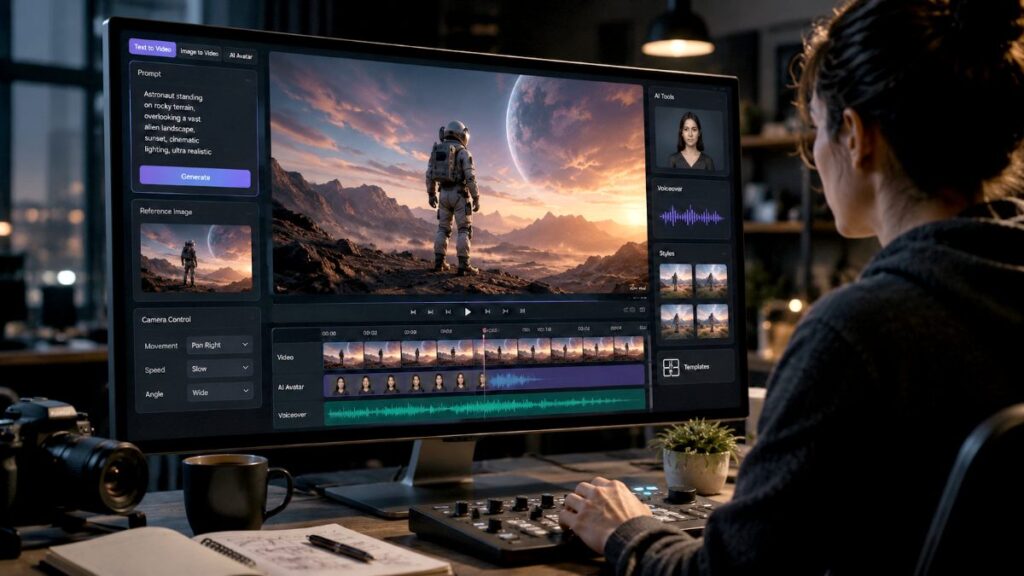
A few years ago, making a convincing video without actually shooting one sounded like a gimmick. Now the question isn’t whether AI can create video. It’s how much of the traditional production process it can realistically replace.
AI video generators are getting better at one of the things that frustrated creators from the beginning: following directions. Characters need to stay recognizable, scenes need to connect, movement needs to look intentional and the finished footage needs to be useful after the initial wow factor wears off.
That’s where the latest generation of tools, including Seedance 2.5, gets interesting.
Not long ago, producing polished video meant cameras, lighting, editing software, stock footage, voice talent and plenty of time. Those things aren’t disappearing, but AI is changing how much of that infrastructure is necessary for every project. A creator can now begin with an idea, script, photograph or other reference and use AI to develop visual material before a traditional shoot ever takes place.
The bigger story isn’t simply that artificial intelligence can make moving pictures. It’s that AI video is beginning to behave more like a production tool.
From AI Experiment to Production Tool
Some of the earliest text-to-video generators were fascinating precisely because nobody knew what they were going to produce. Type in a prompt, wait and see what happened.
That unpredictability was entertaining, but it wasn’t particularly useful for serious content creation.
A prompt might produce a beautiful shot while completely missing the intended mood. Characters could change appearance between scenes. Clothing suddenly looked different. Objects appeared and disappeared. Camera movements could seem disconnected from what was happening on screen.
For a viral experiment, those imperfections could be funny. For someone creating an advertisement, short film, social video or branded piece of content, they were a problem.
The next stage of AI video is increasingly about control.
CapCut’s AI video platform brings generation into a broader creative environment that also includes editing tools, scripts, digital avatars, voiceovers, templates and different video formats. Instead of generating a clip and treating it as the finished product, creators can continue developing the material.
Tools such as the Seedance 2.5 AI video generator show how AI generation is moving toward a more complete production workflow, where generated material can become one component of a larger video rather than simply an impressive standalone clip.
Getting AI to Follow the Creative Direction
The real challenge with generative video has never been whether AI can produce something eye-catching. It has been whether it can produce what the creator actually asked for.
That distinction becomes obvious when multiple shots are involved.
If a woman walks into a restaurant in one scene and sits at a table in another, she needs to look like the same woman. Her clothes shouldn’t inexplicably change. The restaurant should remain recognizable. If a particular handbag or bottle is part of the shot, it shouldn’t suddenly transform when the camera moves.
These details may sound basic, but continuity is one of the things that separates random generated imagery from video that can actually tell a story.
Reference-based generation is helping address that problem. Instead of relying exclusively on a written prompt, newer AI systems can increasingly work from existing visual and creative material to establish what a scene, person or object is supposed to look like.
That changes the relationship between the creator and the technology. Rather than asking AI to surprise them, creators can increasingly use it to execute a specific idea.
Short-Form Video May Be Where AI Makes Its Biggest Mark
TikTok, Instagram Reels and YouTube Shorts have created a strange situation for creators. Video has never been more important, but the lifespan of an individual piece of content can be remarkably short.
A video that takes hours to produce might receive most of its attention within a day or two before the audience moves on to something else.
That creates an enormous appetite for content and considerable pressure to keep producing it.
AI video fits naturally into that environment.
A written concept can become a visual draft. Existing photography can be turned into moving content. A creator can test several visual interpretations of the same idea before deciding which one is worth developing.
For independent creators and small businesses, the economics are particularly interesting. Someone with a good idea doesn’t necessarily need an expensive camera package, elaborate location or full production team simply to see whether the concept works.
It also means production value alone will become less impressive.
When almost everyone has access to sophisticated visual tools, the advantage shifts back toward something technology can’t manufacture quite as easily: having something interesting to say.
Digital Presenters Are Becoming More Practical
AI avatars are another part of the technology moving beyond novelty.
Digital presenters can be useful for educational material, explainers, product demonstrations, training videos and multilingual content. Some AI platforms also allow creators to develop customized avatars instead of relying entirely on stock digital characters.
For publishers and independent media companies, that creates some interesting possibilities.
A written story could be adapted into a short video segment. An instructional video could be updated without organizing another shoot. A creator could produce presenter-led material without having to get camera-ready every time something needs to be posted.
That doesn’t mean every article should suddenly have an AI person reading it aloud.
Audiences still respond to personality, authenticity and good storytelling. Technology can make production easier, but it can’t make dull material interesting simply by putting a digital face in front of it.
The Camera Doesn’t Always Have to Come First
One of the most significant changes brought by generative video is also one of the easiest to overlook.
For more than a century, creating moving images generally began with pointing a camera at something that existed.
Now the starting point can be an idea.
A paragraph can become a scene. A photograph can become moving imagery. A storyboard can become a rough video. A location that would be prohibitively expensive to shoot can potentially be visualized before anyone spends money trying to create it physically.
That doesn’t mean traditional filming is going away.
Real people, actual locations and authentic footage remain essential when reality itself is part of the story. What is more likely is that conventional and AI-generated production will increasingly exist in the same piece of content.
A 30-second video could contain footage shot on a phone, professional photography, an AI-generated establishing shot, a synthetic background, generated visual effects, voiceover and conventional editing.
Eventually, viewers may not spend much time wondering which technique created which shot. They’ll simply decide whether the finished video is worth watching.
The Flood of Mediocre Content Is the Other Side of the Story
There is an obvious consequence to making video dramatically easier to produce: we’re probably going to get a lot more of it.
That isn’t necessarily good news.
AI can solve production problems. It can’t automatically produce a worthwhile idea.
Being able to generate 50 videos quickly doesn’t mean any of those videos deserve an audience. In fact, as AI removes some of the technical barriers to content creation, originality may become even more valuable.
Writing matters. Taste matters. Timing matters. Editorial judgment matters.
This is particularly important for brands and publishers. Filling social feeds with generic AI-generated material simply because it’s inexpensive could produce more content while simultaneously giving audiences less reason to care about it.
The better use of the technology is to remove friction from good ideas.
AI can help visualize a shot that would otherwise be too expensive. It can turn an editorial concept into an initial video draft. It can help create different versions for different platforms or take over repetitive parts of the production process.
But someone still has to know what the story is.
What Comes Next
AI video’s first act was about proving that a computer could generate convincing moving images. The next act is about whether creators can actually use those images.
That’s a much higher bar.
The technology needs better consistency between scenes, greater control over characters and movement, stronger integration between audio and visuals and an easier way to take generated footage from an experiment to a finished piece of content.
Seedance 2.5 is part of that broader transition. What’s notable isn’t simply the ability to generate another impressive AI clip. It’s the continuing movement toward video technology that creators can actually direct, edit and work into a larger project.
That may ultimately be where AI has its biggest impact on video production.
It doesn’t have to replace the camera, the editor, the writer or the person with the original idea. Its more practical role may be removing some of the cost, time and technical barriers between having an idea and actually getting it onto a screen.
And for creators who have spent years with more ideas than production time, that’s a considerably more interesting proposition than another AI-generated video trick.