



1MD Nutrition’s OsteoMD® Complete Bone Support Protocol takes bone health beyond calcium alone, combining calcium with vitamin D3 and vitamin K2 to support stronger bones and more effective calcium utilization. Formulated by rheumatologist Dr. Adam Kreitenberg, OsteoMD reflects a major shift in how experts are looking at bone health: it’s not simply about how much calcium you take, but whether your body has the right nutrients to absorb it, regulate it and use it effectively.
For decades, calcium was treated as the star of osteoporosis prevention. But bone is living tissue, and maintaining it requires an entire biological system. Vitamin D, vitamin K2, magnesium, protein, hormones and physical activity all influence how effectively the body builds and maintains bone.
One nutrient receiving particular attention is vitamin K2.
Most people know vitamin K for its role in normal blood clotting, but K2 is also involved in activating proteins that participate in bone mineralization and calcium regulation. Osteocalcin, for example, is a vitamin K-dependent protein involved in incorporating and organizing minerals within bone tissue. Another vitamin K-dependent protein, matrix Gla protein, is involved in regulating inappropriate calcification outside bone.
That makes K2 an important part of the bone-health equation, particularly when paired with vitamin D.
Vitamin D helps the body absorb calcium and maintain calcium and phosphorus balance. Vitamin K2 helps activate proteins involved in how calcium is utilized. In other words, taking calcium is only part of the story. What the body does with it matters too.

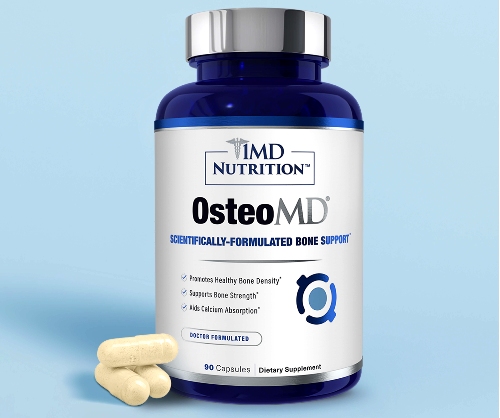
1MD Nutrition’s OsteoMD
Why OsteoMD Takes a Broader Approach
That science is behind 1MD Nutrition’s OsteoMD®, formulated by rheumatologist Dr. Adam Kreitenberg.
Rather than relying on calcium alone, OsteoMD combines calcium with vitamin D3 and vitamin K2, including MenaQ7®, a form of menaquinone-7. The formula also uses calcium hydroxyapatite, a mineral form associated with the structural composition of bone.
The larger point extends beyond any single supplement.
Maintaining bone strength becomes increasingly important with age, particularly for postmenopausal women and people at elevated risk for osteoporosis and fractures. Nutrition matters, but so do resistance and weight-bearing exercise, adequate protein intake, vitamin D status, hormonal changes, underlying medical conditions and, for some patients, prescription osteoporosis medications.
Supplements can help fill nutritional gaps. They are not substitutes for the rest of the equation.
We went directly to the physician behind OsteoMD. Dr. Adam Kreitenberg, rheumatologist and 1MD Nutrition® physician formulator, explains what has changed in our understanding of calcium, why vitamin K2 has become such an interesting part of the bone-health conversation, and what a genuinely comprehensive strategy for protecting bones looks like today.
Q&A With Dr. Adam Kreitenberg
LA’s The Place: For years, calcium was treated as the single silver bullet for bone density. What did early recommendations miss, and why is the medical community moving away from looking at calcium in isolation?
Dr. Adam Kreitenberg: Calcium is absolutely essential for bone health, but bone is a living tissue that requires much more than calcium alone. We now understand that vitamin D, vitamin K2, protein, magnesium, physical activity and hormonal factors all influence how effectively the body builds and maintains bone. Simply increasing calcium intake does not necessarily translate into stronger bones or reduce fracture risk if the other components of bone metabolism are inadequate. That is why I prefer a comprehensive approach, such as the nutritional strategy incorporated into 1MD Nutrition’s OsteoMD along with weight bearing exercise, rather than thinking about calcium as a standalone solution.
LATP: When calcium enters the bloodstream without the necessary cofactors, where does it end up, and what are the clinical risks of unguided calcium intake?
Dr. Kreitenberg: The body regulates blood calcium very tightly because calcium is critical for maintenance of bone health but also muscle contraction, nerve signaling and other functions. It is an oversimplification to say that calcium without vitamin K simply “goes to the arteries,” but excessive or unnecessary calcium supplementation may contribute to unwanted calcium deposition in certain circumstances. There is also concern about kidney stone risk and calcium deposition in and around joints and cartilage in some individuals, particularly when total calcium intake is excessive or supplementation is poorly targeted. My approach is to make sure patients meet their calcium needs primarily through diet when possible and use supplementation strategically, along with vitamin K2 rather than assuming more calcium is always better.
LATP: Most people associate Vitamin K strictly with blood clotting. How does it function behind the scenes to guide calcium into the bone structure?
Dr. Kreitenberg: The two main natural Vitamin K subtypes include Vitamin K1 and K2. Vitamin K1 goes to the liver to help produce blood clotting factors, while Vitamin K2 has an important role in activating several proteins involved in bone metabolism. Among those, osteocalcin helps support the incorporation and organization of minerals within bone tissue and matrix Gla protein is involved in regulating inappropriate calcification outside of bone. So, vitamin K2 is better thought of as part of the body’s calcium-management system, although we should be careful not to oversimplify it as literally “directing” every calcium molecule into bone.
LATP: What is the practical difference between Vitamin K1 and Vitamin K2, and why has K2 become such a central focus in recent bone health research?
Dr. Kreitenberg: Vitamin K1, or phylloquinone, is found predominantly in leafy green vegetables and plays an important role in normal vitamin K metabolism and the production of blood clotting factors. Vitamin K2 refers to a family of menaquinones, which are found in certain fermented foods and animal products and have different biological properties. K2, particularly forms such as menaquinone-7, has attracted significant interest because of its longer persistence in the body and its role in activating vitamin K-dependent proteins involved in bone and calcium metabolism. That is one reason I find the inclusion of vitamin K2, specifically the MenaQ7 form, in OsteoMD particularly appealing as part of a comprehensive bone-health strategy.
LATP: Vitamin K and Vitamin D are frequently described as a team. How do these two nutrients work in tandem to support bone matrix strength?
Dr. Kreitenberg: Vitamin D helps the body absorb calcium from the gastrointestinal tract and plays an important role in maintaining calcium and phosphorus balance. Vitamin K2, meanwhile, is required to activate proteins involved in bone mineralization and calcium regulation. In simple terms, vitamin D helps make calcium available, while vitamin K2 helps ensure that important calcium-regulating proteins are functioning properly leading to better bone mineralization. That complementary relationship is one reason I look for both nutrients when evaluating a comprehensive bone-health supplement such as OsteoMD.
LATP: When patients walk into your office already taking bone supplements, what is the most common misconception you find yourself clearing up?
Dr. Kreitenberg: The most common misconception is that taking a large amount of calcium automatically means you are protecting yourself against osteoporosis. Bone health is much more complicated than a single nutrient, and supplements cannot compensate for inadequate exercise, poor nutrition, smoking, excessive alcohol consumption or an underlying medical condition affecting bone. I also remind patients that supplementation should complement, not replace, a healthy diet and an appropriate medical evaluation. The goal should be to identify nutritional gaps and address them systematically and intelligently rather than simply taking the highest dose available.
LATP: Is there a point where taking extra calcium actually backfires, and how should consumers separate real clinical dosage from savvy marketing?
Dr. Kreitenberg: More is not necessarily better with calcium, and the appropriate amount depends on age, sex, diet, medical history and individual fracture risk. Excessive supplemental calcium can increase the risk of gastrointestinal side effects and may increase kidney stone risk in susceptible individuals. I recommend that patients prioritize calcium-rich foods as part of a healthy diet while recognizing that supplementation can be an important complement to dietary calcium to help ensure adequate intake and support overall bone health. I also appreciate that OsteoMD uses calcium hydroxyapatite, the primary form for bone mineralization, providing bone with strength and structural integrity, rather than relying exclusively on traditional calcium salts. Consumers should look beyond marketing claims and consider whether a supplement provides evidence-based nutrients in appropriate forms and amounts, which is an important part of the formulation philosophy behind OsteoMD.
LATP: For high-risk groups, particularly postmenopausal women, what does a truly comprehensive bone preservation strategy look like right now?
Dr. Kreitenberg: For a postmenopausal woman at increased risk, I start with an assessment of fracture risk and bone mineral density with a DXA scan. Subsequently, I assess nutrition, vitamin D status, physical activity and other modifiable risk factors. From a lifestyle modification standpoint, resistance and weight-bearing exercise are particularly important because bone responds to mechanical loading. Adequate protein, calcium and vitamin D intake are foundational, while nutrients such as vitamin K2 may provide additional nutritional support for normal bone metabolism. For women with osteoporosis or sufficiently high fracture risk, however, nutritional support should accompany, not replace, evidence-based prescription osteoporosis therapies when those treatments are indicated.
LATP: Supplements are only one piece of the puzzle. How do resistance training and prescription medical treatments interact with targeted nutritional support?
Dr. Kreitenberg: I think about bone health as a three-part strategy: mechanical stimulation or loading, adequate nutritional building blocks and, when necessary, medical treatment. Resistance and weight-bearing exercise provide the physical stimulus that tells bone it needs to remain strong. While adequate protein, calcium, vitamin K2, vitamin D and other nutrients provide the raw materials and cofactors involved in bone metabolism. Prescription osteoporosis medications can reduce fracture risk in appropriate patients by targeting specific pathways involved in bone resorption or formation. A well-designed, comprehensive nutritional supplement such as OsteoMD can support that overall strategy.
LATP: When you set out to formulate a protocol like OsteoMD, what specific nutrient synergies were non-negotiable for real biological results?
Dr. Kreitenberg: The most important principle when formulating OsteoMD was that bone health is multifactorial, so I would not want to build a formula around calcium alone. OsteoMD combines calcium with vitamin D3 and vitamin K2, including the MenaQ7 form of K2, to address complementary aspects of calcium absorption, utilization and bone metabolism. Importantly, the OsteoMD uses ingredients that have been clinically studied, with key nutrients provided at doses that have been studied for their role in supporting bone health. That combination reflects how I approach patients clinically: rather than focusing on one nutrient in isolation, address multiple components of bone health while keeping exercise, diet and appropriate medical treatment at the center of the strategy.
Go to 1MD Nutrition® for more information and to see all of their incredible formuations that they offer.