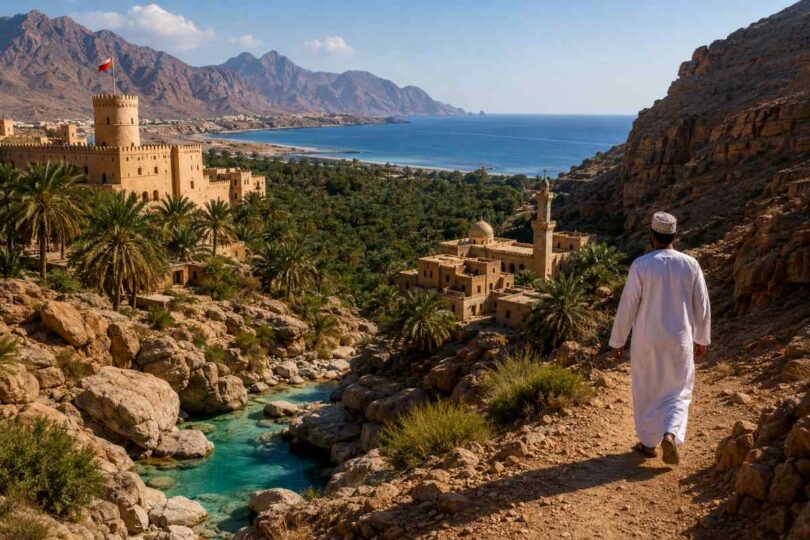

There’s a quiet confidence to Oman that takes most visitors by surprise. Unlike its neighbors, Dubai with its relentless ambition, Saudi Arabia mid-reinvention, Oman has always known what it is. Ancient, unhurried, and genuinely hospitable in a way that doesn’t feel performed.
I’ve spoken with dozens of travelers who chose Oman almost as an afterthought and left, considering it the best trip they’d ever taken. That reaction has become so consistent it no longer surprises me.
Here’s what you need to know before you go.
Oman Is Not What Most Americans Picture
Mention the Middle East to most travelers and the images that surface are predictable, desert megacities, luxury malls, man-made islands. Oman fits none of these categories.
The country sits on the southeastern tip of the Arabian Peninsula, sharing borders with the UAE, Saudi Arabia, and Yemen, but occupying a cultural and geographical space entirely its own. The Hajar Mountains run along its northern spine, dropping into wadis, seasonal riverbeds carved through limestone over millennia, before the land opens into the vast red dunes of the Wahiba Sands. The capital, Muscat, hugs a dramatic coastline between black volcanic hills and the Gulf of Oman.
It is, in the most honest sense, a landscape that earns the word stunning.
The Practical Case for Going Now
Oman’s tourism infrastructure has improved dramatically over the past decade without overwhelming the experience. Hotels range from basic guesthouses to genuinely world-class properties. Roads are excellent. The country is consistently ranked among the safest destinations in the Middle East for international travelers. English is widely spoken in cities and tourist areas.
Entry is straightforward for American passport holders, who can obtain a visa on arrival or apply for an e-visa before departure. The fee is minimal and processing is routine.
Best time to visit Oman: October through April. Temperatures during this period hover between 68°F and 90°F at sea level, warm but manageable for outdoor activity. Summer months (June through August) push temperatures above 110°F in the interior and should be avoided outside of Salalah, which experiences its own monsoon season from July to September.
How many days do you need? A minimum of seven days for a meaningful trip. Ten days allows a comfortable loop from Muscat through the coastal wadis, desert, and mountains without feeling rushed.
What to Actually Do in Oman
Muscat deserves at least two full days. The Sultan Qaboos Grand Mosque opens to non-Muslim visitors Saturday through Thursday, 8 AM to 11 AM. Arrive early. The main prayer hall’s hand-woven Persian carpet covers over 4,000 square meters, the second largest in the world. The chandelier above it weighs over 8 tons and is encrusted with Swarovski crystals.
Mutrah Souq runs along the harbor and functions as a genuine market, not a tourist set piece. Frankincense, silver khanjar daggers, dried limes, and Omani coffee fill stalls that have operated in a similar form for centuries. Walk the Corniche afterward as the city cools into the evening.
Wadi Shab — located two hours south of Muscat on the coastal highway, consistently lands as the experience travelers remember longest. The approach involves a short boat crossing (1 Omani Rial per person), a forty-five-minute canyon hike, and then swimming. The trail ends at a deep pool where the only way forward is through the water. Push through a narrow rock crack, and you emerge into a cavern with a waterfall dropping from a hole in the ceiling twenty meters above.
It is the kind of place that makes people reconsider how they spend their vacation time.
Wahiba Sands provides the desert experience done right, high dunes reaching up to 100 meters, Bedouin camp nights, and a silence at 3 AM that most urban travelers have never encountered. A one-night stay covers the essentials: arrive late afternoon, watch the sunset, sleep under dense desert stars, and leave after sunrise.
Nizwa, ninety minutes inland from Muscat, anchors any itinerary covering the historical interior. The 17th-century circular fort dominates the skyline. The traditional souq beside it still runs a livestock market on Friday mornings, an experience unchanged for centuries.
Jebel Akhdar (the Green Mountain) rises above 2,000 meters and requires a 4WD vehicle. Terraced villages grow roses and pomegranates at altitude. The views across Wadi Ghul — Oman’s answer to the Grand Canyon, are among the most dramatic in Arabia.
How to Plan Your Oman Trip
Most visitors underestimate Oman’s size. The country spans over 300,000 square kilometers, and distances between highlights are longer than they appear on a map.
For American and international travelers, working with Oman private tours specialists removes the logistical complexity of planning a multi-destination itinerary. Local operators understand the details that matter, which mountain roads require 4WD, when the Jebel Akhdar checkpoint opens, how to time a wadi visit to avoid midday heat, and which desert camps offer authentic experiences rather than staged ones.
Average daily budget in Oman:
- Budget traveler: $80–100 per day
- Mid-range: $150–250 per day
- Luxury: $400+ per day
All prices include accommodation, food, and transport.
Oman Travel: Frequently Asked Questions
Is Oman safe for American tourists? Yes. Oman consistently ranks among the safest countries in the Middle East for international visitors. Crime rates are extremely low and the culture is welcoming toward foreign travelers.
Do Americans need a visa for Oman? American passport holders receive a visa on arrival at Muscat International Airport. E-visas can also be obtained in advance online. The visa allows stays of up to 30 days and costs approximately $20.
What is the best time of year to visit Oman? October through April is the primary travel window. Temperatures are comfortable for outdoor activities, including wadi hiking and desert camping. July through September is best avoided in northern Oman due to extreme heat.
What is Wadi Shab and why is it famous? Wadi Shab is a limestone canyon located approximately 150 kilometers south of Muscat. It is famous for its turquoise swimming pools and a hidden waterfall cave that can only be reached by swimming through a narrow rock crack. It is consistently rated as one of the top natural attractions in Oman.
How do I get from Muscat to Wahiba Sands? Wahiba Sands is approximately 220 kilometers (3 hours by car) from Muscat via the town of Bidiya. A 4WD vehicle is strongly recommended for driving in the desert. Most visitors join organized tours or hire a private driver for the journey.
Is alcohol available in Oman? Alcohol is available in licensed hotel bars and restaurants but is not sold in supermarkets or public areas. Travelers staying in international hotels will have no difficulty finding it.
What currency does Oman use? Oman uses the Omani Rial (OMR). The Rial is one of the highest-valued currencies in the world, 1 OMR equals approximately $2.60 USD. ATMs are widely available in Muscat and major towns.
One Final Note
Oman is changing. Tourism numbers have climbed steadily, and the government has invested significantly in expanding capacity. The wadis are busier than they were five years ago. The infrastructure that makes visiting easier also makes the experience slightly more predictable each year.
Go while it still requires a little effort. That effort is precisely what makes it matter.