


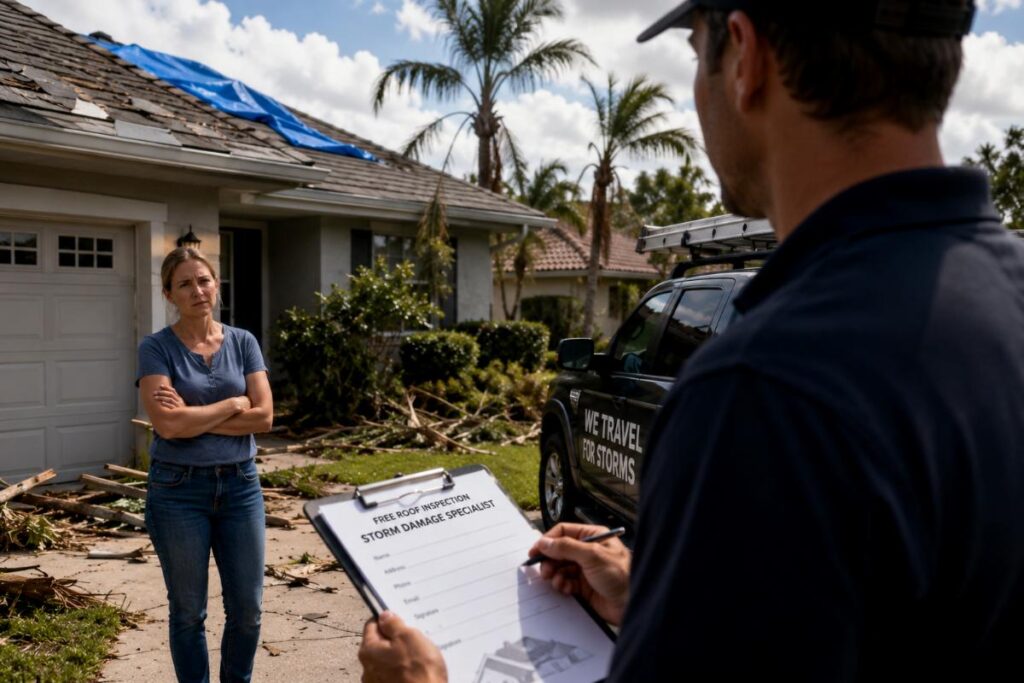
A pickup rolls into your Lakewood Ranch driveway two days after the wind finally quits, and the friendly guy with a clipboard says your roof is shot. Maybe it is, but the residential roofing companies lakewood ranch fl homeowners actually recommend are rarely the ones knocking on doors first. The good crews are already booked, already permitted, and backed up with insurance paperwork for the neighbors who called them last season. He can start Monday, he says, and that speed is the entire pitch.
Here is what most people miss in the scramble after a storm. The single best predictor of a roof that survives the next one is not the shingle brand or the length of the warranty. It is whether you can verify the crew before they ever climb a ladder. The case we see most often is a homeowner who signed fast, paid a deposit, and then spent six weeks calling a phone number that had already stopped working. A roof is a twenty-year decision, and a storm chaser wants you to make it on a two-day clock.
A License Number Is Not A Formality
Florida licenses roofing contractors for a reason, and a real company hands you the number before you ask. A certified roofing contractor carries a license beginning with CCC, valid across the state, and you can check its status yourself in about a minute on the state portal. Look for two words: Current, Active. Anything else, expired, suspended, closed, is a hard stop. A crew working under someone else’s number, or no number at all, is committing a first-degree misdemeanor under Florida law, no matter how clean the finished roof looks from the street. That should matter to you for a practical reason and not a moral one, because an unlicensed install voids most manufacturer warranties and hands your insurer a clean reason to deny the next claim. Ask for the license, a certificate of insurance, and confirmation they will pull a permit in Manatee County, then watch how quickly the mood shifts if any one of the three turns into a problem.
Why obsess over the crew instead of the product? Because the details they either nail or skip are what stand between your family and the next Category 3. A peer-reviewed study from the University of Alabama’s Center for Risk and Insurance Research found that homes built to the Fortified Roof standard filed 73% fewer claims after Hurricane Sally than homes built to standard code. Same storm, same streets, very different mornings after, and the gap came down to sealed decks, ring-shank nails, and a crew that actually followed the spec. A chaser is not picturing your roof in 2034. He is picturing being three counties over by Friday.
The Pressure To Sign Today Is The Tell
Ten years ago a storm chaser worked a subdivision with a yard sign and a stack of flyers. Today the pitch arrives by text, the contract is a tablet slid across your kitchen table, and the urgency is manufactured right down to the hour. The move that should end the conversation is an offer to waive your insurance deductible, sometimes dressed up as a free roof. In Florida that is not a discount. It is illegal, and a contractor who leads with it is telling you precisely how he treats every other rule.
Run the math on that free roof and it collapses. Say your dwelling coverage is $360,000 and your policy carries a 2% hurricane deductible. That is $7,200 you are responsible for on a replacement your insurer approves at, say, $21,000. When a chaser offers to eat that $7,200 so you pay nothing out of pocket, the money does not disappear. It comes back as thinner underlayment, fewer nails per shingle, and a skipped permit, which leaves you owning a $21,000 roof built to hit a number instead of a code. The deductible was never the expensive part.
None of this relaxes in a quiet year. NOAA’s May 2026 outlook pegged the odds of a below-normal Atlantic season at roughly 55%, and that is exactly when homeowners drop their guard. One good gust still finds the roof that was installed to a deadline. A pulled permit is part of the defense, and pulling one in Manatee County runs a couple hundred dollars. Call it $250. Honestly, closer to $400 once the re-roof valuation and inspection fees land, and a chaser skips it anyway, because a permit invites a county inspector he would rather keep off the property.
Hire The Roof, Not The Rush
Slow down, and the decision actually gets easier. The roof thrown up over a weekend rarely sees its tenth birthday, while the one installed by a crew you took the time to vet tends to outlast the loan on the house. Start with the fasteners that do the real work when the wind comes, because those are the first things a rushed crew shorts you on. The Asphalt Roofing Manufacturers Association requires a minimum of four nails per full-size strip shingle, each at least 12 gauge, and a chaser paid by the square quietly cuts that count to save a few minutes on every bundle. The best residential roofing companies lakewood ranch fl has to offer will put a license number, a permit plan, and a written scope in your hands before you have to ask twice. Check the license. Read the scope. Then hire the roof, not the rush.