


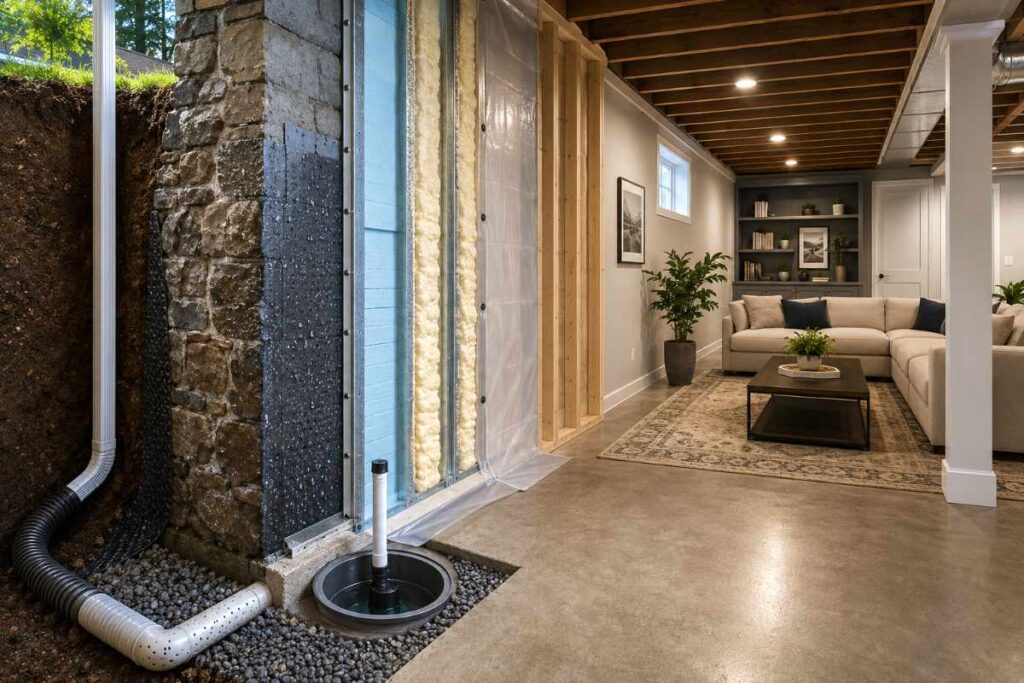
Most homeowners think finishing a basement is a framing and drywall job. The truth behind the kind of basement finishing Massachusetts homes need is that it begins as a water problem, not a carpentry one. A finished basement is a moisture project first, and only a build that seals and insulates the shell before anyone frames a wall gives you a room that stays dry and actually gets used. Skip that order and you get a mildew smell by the second spring.
Every Damp Basement Starts The Same
The case we see most often is an older Massachusetts home with a fieldstone foundation, the kind laid up a century ago and never meant to hold back groundwater. Come the spring thaw the mortar joints start weeping, a musty smell settles into the stairwell, and the whole level gets written off as storage. A fieldstone wall keeps its own schedule, and it lets water through wherever the grade outside pitches back toward the house. A quick moisture meter reading on the slab usually settles the question before any demo starts. That is the first thing to fix, long before you price a single sheet of drywall. Most of these basements were dry enough in August and soaked by April, which tells you the real culprit is seasonal water, not one leak you can patch in a spot.
Seal The Foundation Before Framing Anything
Water management outside the wall matters more than any sealant you brush on the inside. The University of Minnesota Extension notes that a single one-inch rain drops about 1,250 gallons on a 2,000-square-foot roof. It recommends the soil grade fall at least one inch per foot for the first six feet out from the foundation. Downspout extensions that carry runoff six to ten feet out often do more than any interior coating. Fix the gutters and the grading and you cut the load hitting that fieldstone before it ever reaches the interior. Inside, the sequence runs drainage first, then a vapor barrier, then framing, never the reverse. Frame against a damp wall and you have sealed mold inside the assembly where nobody can reach it.
Insulation Decides How A Room Feels
A sealed basement can still feel like a cave if the insulation is wrong. Ten years ago the default was fiberglass batts stuffed between furring strips against the concrete, which trapped humidity and grew mold within a few winters. Today most crews run rigid foam board or closed-cell spray foam directly against the foundation, which stops warm interior air from meeting cold concrete and condensing. That is the dew point problem, where the wall sweats from the inside even when no water comes through the block. Even a good dehumidifier struggles to keep up when the wall itself is the moisture source. A basement finished this way holds a steady temperature and loses the damp chill that made the space unusable. The difference is not subtle once you spend a February evening down there.
The First Ninety Days After Finishing
A good finish reveals itself over the first season, not on the final walkthrough. The first week you are watching for any smell after a hard rain, which tells you the drainage is holding. By month three you want stable humidity readings and no staining at the base of the new walls. Keep a simple log of those numbers so you can spot a slow climb early. Within 90 days a properly sealed room has weathered at least one heavy storm and proven it stays dry.
Attachment points are where finished spaces quietly fail. The North American Deck and Railing Association ties about 90% of deck collapses to the ledger connection. It sets a 200 pound load standard on guard posts for the same reason, since one weak joint can undo an entire assembly. A basement is no different, and the seal between foundation and frame is the connection that decides whether the room lasts. Budget maybe $6,000 for the moisture and structural work. Honestly, closer to $9,000 once exterior grading and a sump pump get figured in on an older foundation.
A Dry Space Earns Its Cost
A dry, finished basement pays for itself as square footage you actually use, whether that becomes a home office or a guest suite. A reclaimed lower level can add real, livable room without the cost of a full addition. Homeowners are clearly willing to bring in help for work at this scale. A July 2026 read of the Houzz Outdoor Trends Study put the share of homeowners hiring at least one pro at 71%, up from 65% in 2024, with fewer people renovating purely for resale. That shift tells you owners are investing in spaces they plan to live in, not just flip. Done in the right order, basement finishing Massachusetts homes can rely on turns a damp, skipped level into the driest room in the house. Handle the water first and the framing and finish work go in cleanly.