



The opioid crisis continues to affect families and communities across the country, and fentanyl remains one of its most dangerous contributors. While public awareness has grown and life-saving treatments like Narcan have become more widely available, those tools are designed to respond after an overdose has already occurred. DEFENT is taking a different approach by focusing on prevention before tragedy has the chance to happen.
Its flagship innovation, DEFENT ONE, is the world’s first and only patent-pending all-in-one portable fentanyl detection device. Designed to be compact enough to fit in a pocket while remaining simple enough for virtually anyone to use, the device offers a practical way to test substances quickly whether at home, traveling, attending a concert, or spending the weekend at a music festival.

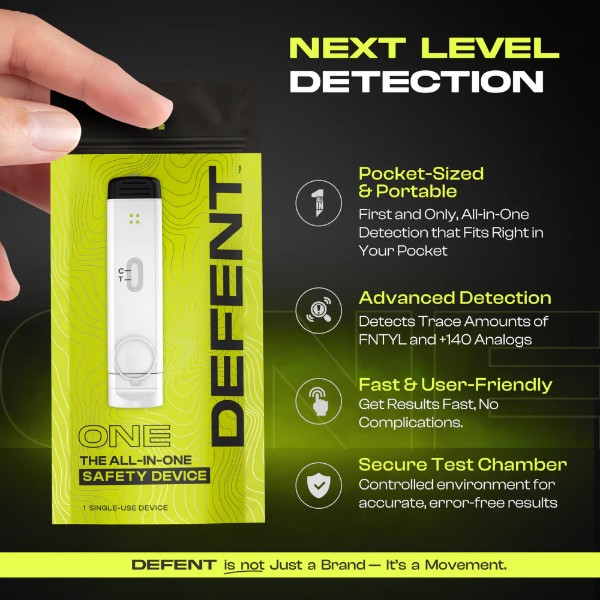
DEFENT ONE: Portable Fentanyl Detection
Unlike traditional fentanyl test strips, which often require multiple supplies and careful measuring, DEFENT ONE brings everything together in a single device. It includes a pre-measured scoop, deionized water, easy-to-read result lines, and straightforward step-by-step instructions. The goal is to remove the guesswork that can make testing difficult, especially when someone is away from home or in a fast-moving environment.
That portability becomes especially relevant during festival season, when large crowds, unfamiliar surroundings, and shared substances can increase risk. Rather than relying solely on emergency interventions after an overdose occurs, DEFENT ONE encourages people to pause for a moment, gather information, and make more informed decisions before consuming anything.
The company believes education and awareness should be accessible to everyone. Fentanyl contamination is no longer viewed as an issue affecting only one demographic. It has touched people across every age group, profession, and community, making conversations about prevention more important than ever.

DEFENT’s mission extends well beyond developing a single product. The company hopes to normalize substance testing in much the same way seatbelts became an accepted part of everyday driving. The idea is simple: safety precautions don’t encourage risky behavior—they help reduce the consequences when risks already exist.
That philosophy has helped shape DEFENT into more than a technology company. It has become an advocate for practical harm reduction, encouraging individuals, families, and entire communities to have honest conversations about fentanyl while reducing the stigma that often prevents those discussions from happening.
As awareness continues to grow, innovations like DEFENT ONE demonstrate how technology can complement education and community outreach by giving people another tool that emphasizes prevention rather than reaction. In a public health crisis where every informed decision matters, providing people with simple, portable ways to protect themselves may ultimately save lives.
Q&A with Ahmad Hussain, Founder of DEFENT
LAsThePlace.com: What was the moment or experience that inspired you to create DEFENT ONE?
Ahmad Hussain: There wasn’t a single moment. It was a steady build from 2015 to 2022, when I lost both family members and friends to unintentional fentanyl poisonings. At the time, I was working in the diagnostics field, and I realized I had both the experience and the purpose to create a solution that could help save lives.
LATP: Why did you feel existing fentanyl testing options weren’t enough, and what gap were you trying to fill?
Hussain: At the time, fentanyl test strips had very little brand recognition, which meant there wasn’t a lot of public trust in them. There were also issues with cross-reactivity that could produce false positives with certain substances. Even the strips that performed well weren’t always practical for every situation. We wanted to create something people could easily use wherever they were.
LATP: DEFENT describes itself as a movement as much as a product. What kind of cultural change are you hoping to create?
Hussain: Although fentanyl test strips are available through many government programs, a large percentage of people still don’t test before consuming a substance. Our goal is to remove the stigma around harm reduction and make testing as common as carrying your phone or wallet. We also built an anonymous reporting tool that allows people to share information when they discover substances contaminated with fentanyl, helping protect others in the community.
LATP: You often compare fentanyl testing to wearing a seatbelt. Why is that analogy so important to your mission?
Hussain: There are still people who believe harm reduction products somehow encourage drug use. That simply isn’t true. Wearing a seatbelt doesn’t mean you’re planning to get into a car accident, and the availability of condoms doesn’t cause people to have more sex. Testing is simply a safety measure that gives people more information before making a decision.
LATP: What makes DEFENT ONE different from traditional fentanyl test strips in terms of usability and accuracy?
Hussain: Fentanyl test strips are an excellent tool and have an important place in harm reduction. However, they’re generally designed for use in a controlled environment. When people try to use them on the go, the dilution process is often done incorrectly, making the results unreliable. DEFENT ONE was designed specifically for portability and ease of use. We’re not suggesting people replace test strips—we simply want everyone to use whichever testing method works best for their situation.
LATP: Festival season has become a major focus of fentanyl awareness. Why do you believe eventgoers are such an important audience for this technology?
Hussain: Festivals are fast-paced environments where people frequently share everything from water bottles and sunscreen to substances. Our device allows someone to pause for just a moment and verify that what they’re about to consume hasn’t been contaminated with fentanyl.
LATP: Have you heard any stories from users where DEFENT ONE may have helped prevent a dangerous situation?
Hussain: Almost every week we receive anonymous reports from people who discovered fentanyl in a substance they otherwise would have consumed. Those reports reinforce exactly why we created DEFENT ONE in the first place.
LATP: The fentanyl crisis affects people from every background. How do you approach conversations about safety without creating stigma or judgment?
Hussain: We lead with facts and data. That helps remove the perception that any one group is being singled out. The reality is that fentanyl affects every demographic, and today most people are only one or two degrees removed from someone who has experienced an overdose.
LATP: What challenges have you faced bringing the world’s first all-in-one fentanyl detection device to market?
Hussain: One challenge has been seeing opioid settlement funds diverted toward closing budget gaps instead of responding directly to the opioid crisis. On the retail side, many major retailers remain hesitant to stock products in this category, even though consumer demand clearly exists. Overcoming those barriers has been one of our biggest hurdles.
LATP: Looking ahead five years, what would success look like for DEFENT and for fentanyl awareness in general?
Hussain: Success would mean testing becomes second nature—just like putting on a seatbelt before driving. If testing becomes standard practice before purchasing or consuming substances, contaminated products become much harder to sell. Over time, that kind of widespread adoption has the potential to disrupt the illicit drug supply chain and save countless lives.
For more information about DEFENT ONE, visit https://defent.com, follow @defentofficial on Instagram, or watch the product demonstration video on YouTube to see how the device works.