


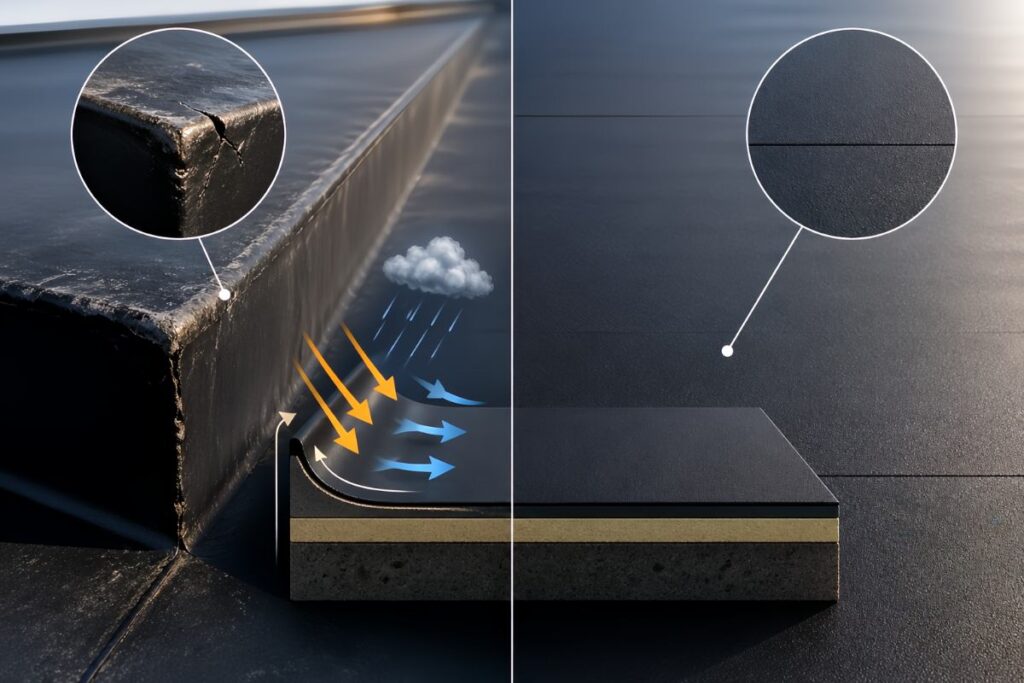
If you ever spend time on a flat roof, you might notice that most of the surface looks pretty uniform. This wide open space is known as the field. It usually holds up well against the elements because it is just one continuous sheet of material doing its job. However, once you get to the edges and corners, the story changes completely. When homeowners or building managers look for a roof repair St. George service, the most frequent culprit behind their leak isn’t a hole in the middle of the roof. Instead, it is almost always a failure at an exposed corner or a vertical transition. These areas are the true weak points of any membrane system.
The Physics of Wind Uplift and Vortexing
The most aggressive enemy of a flat roof is wind. When wind hits the side of a building, it doesn’t just stop. It rushes upward and rolls over the edge of the roof. This creates something called a pressure differential. While the field of the roof feels some suction, the corners experience intense, localized turbulence known as vortexing.
Think of it like the corners of a book being flipped by a fan. The middle pages stay down because of their weight and surface area, but the corners catch every bit of air. On a roof, these constant micro-tugs on the membrane eventually fatigue the material. Over time, the adhesive or the mechanical fasteners holding the corner down begin to loosen. Once a corner lifts even a fraction of an inch, the wind gets underneath it, and the wear and tear accelerates.
Expansion and Contraction Stress
Materials like TPO, EPDM, and PVC are designed to be flexible, but they still move when the temperature changes. This is called thermal expansion. In the field of the roof, the membrane can expand and contract relatively evenly across a large area. There is plenty of room for the material to “breathe” as the sun heats it up and the night cools it down.
Corners are a different animal. At a corner, the membrane is often folded, cut, or wrapped around a ninety-degree angle. This creates a point of high tension. Because the material is being pulled in two or three different directions at once, it cannot move as freely as the field area. This restricted movement leads to stress cracking. In the heat of the summer, the corner is stretched to its limit, and in the cold of winter, it becomes brittle. Eventually, the material at the fold starts to thin out and crack, leaving a direct path for water to enter the building.
Complexity of the Flashing and Seams
Installing a membrane on a flat field is fairly straightforward. You roll out the material and weld or glue the long straight seams. It is a repeatable process with a low margin for error. Corners, however, require intricate detail work. A roofer has to cut “pigs’ ears” or use pre-fabricated corner boots to seal the area where the walls meet the floor of the roof.
Every time a human has to make a manual cut or a hand-weld, the risk of a mistake goes up. These detail areas rely heavily on the skill of the installer. If the heat gun was a few degrees too cool or if the technician didn’t apply enough pressure with the silicone roller, the bond might look fine but fail within a couple of years. Since corners have more seams per square inch than any other part of the roof, they are naturally more prone to failing faster than the simple, flat sections.
Mechanical Damage and Foot Traffic
Corners are also magnets for physical damage. Most rooftop equipment, like HVAC units, vents, and pipes are tucked away near edges or corners to keep the field clear. When service technicians go up to fix an air conditioner, they often stand, kneel, or drop tools right in those corner transitions.
Unlike the field, which is a flat cushion, a corner has a hard edge underneath it. If someone steps heavily on a membrane that is stretched tightly over a sharp metal corner or a wooden nailer, it can create a puncture. The field of the roof can usually take a bit of foot traffic without much drama, but the tension at the corners makes them much more vulnerable to being sliced or bruised by accidental contact.
Final Word
Understanding why corners fail is the first step in extending the life of your commercial or residential flat roof. While the field might look like the most important part because of its size, the corners are where the real battle against the weather happens. If you notice any lifting or cracking near your roof edges, calling a roof repair St. George service immediately can save you from a massive internal leak. Keeping those high-stress points reinforced and inspected will ensure your entire membrane system lasts as long as it was designed to