


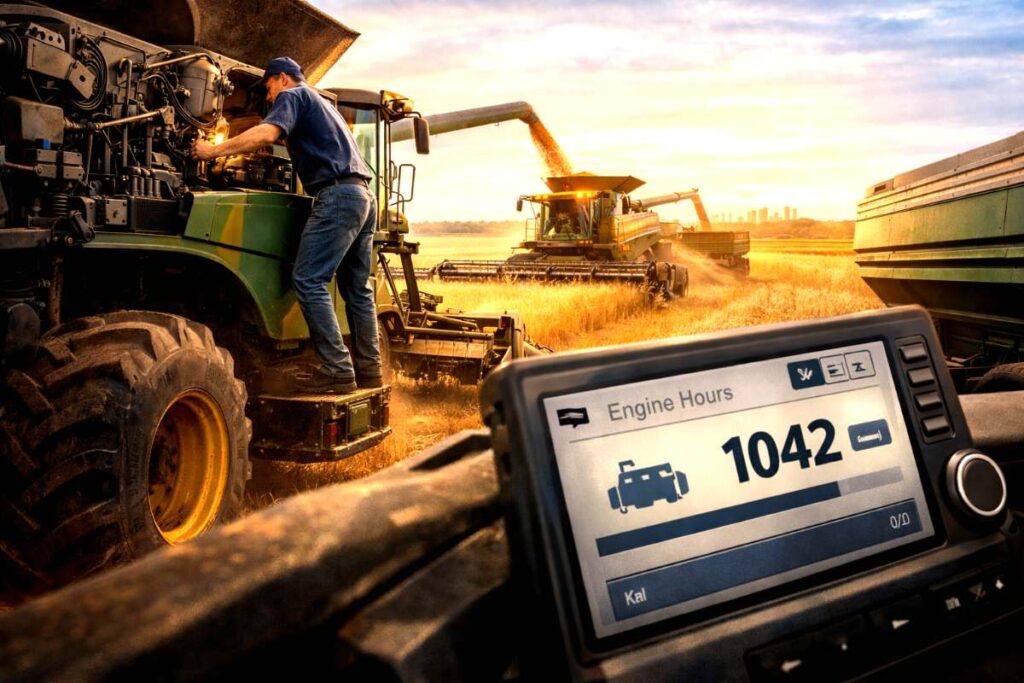
Experiencing a breakdown when you’re preparing to plant is tough. Having one when you’re trying to bring in the crop can be catastrophic – the cost of lost days mounting up quickly.
The difference between suffering through a few days of downtime or having most of your fleet out of operation for days or weeks – or even the entire season – often comes down to how you view your machinery.
The Harvest Readiness Audit: Do It 30 Days Out
Many fleets already run a pre-season check. Few of them do it early enough for it to matter. Plan your full harvest readiness audit at least 30 days before your first cut. This enables you to actually act on what you find, rather than just documenting a handful of issues and hoping they hold for a couple more months (or for a year).
Focus on the parts that fail under sustained heat and continuous use, as they’re the most likely to give out under the heavy demands you place on them during harvest: belts, hoses, and brake pads, in particular. These parts coast toward the end of their lifecycles in normal operation but rocket toward failure when a vehicle is running nearly around the clock in high ambient temperatures. A cracked serpentine belt creates a kind of snowball effect: the more it splinters, the harder the remaining pieces undergo stress – which only fragments them further. If you find that belt laying in the shop, it’s a two-hour fix. If you’re looking for it on a rural road at 2 a.m. with a loaded trailer, it’s a different scenario.
Tires Take More Abuse Than Most Operators Account For
Hauling crops isn’t like hauling any other freight. Traditional commercial freight lives in an environment of demand and lead time. Retail deliveries idle time in the dock. Auto parts can wait. Manufacturers build backup stock or run 24/7 to avoid disruptions for their just-in-time supply chain.
But that rainy-day cushion isn’t part of the agricultural reality. The harvester doesn’t stop just because there’s rain in the forecast. When the crop’s ready, the crop’s ready. And a tire failure is not an acceptable reason to hold up the operation.
Hydraulics Need Daily Attention, Not Periodic Checks
People with experience of hydraulic failures know that it’s less a question of whether the equipment will fail, and more a question of when – unless you have a good maintenance strategy. If times are busy and maintenance is delayed, hydraulic issues will increase exponentially faster than you can catch up.
For reliable ag transport operations, especially those moving bulk commodities from the field to processing facilities or grain elevators, the delivery schedule is only as dependable as the equipment executing it. One delayed load during a tight weather window can affect contractual delivery commitments in ways that don’t get fixed by the next run.
Telematics and Engine Hours: a Better Maintenance Signal
Unscheduled breakdowns are expensive in agricultural logistics. The average cost is more than $450 per hour in lost productivity and repairs, not including perishable cargo loss. With costs like that, predictive maintenance starts to feel less like a burden and more like an insurance policy.
Telematics platforms track engine hours, not just mileage – and that distinction matters for field-staged vehicles that idle heavily during loading and staging. Maybe one of your trucks has only traveled 300 miles but has run 40 engine hours. It likely needs maintenance more than another truck that has taken the same trip but stuck to the open highway. This measure also accounts for other heavy idling scenarios.
If you are already using ELDs in your vehicles to stay in compliance with most local and federal regulations, you may be able to use some features of those systems to help you track maintenance intervals too. Because every vehicle will soon be required to have an ELD, it’s an easy, accurate, and paperless way to track engine hours.
The Off-Season is When the Season Gets Won
Internal mechanics are valuable. They’re also finite. When your fleet is running 24/7 during peak harvest, your maintenance team’s capacity is already spoken for by daily inspections and reactive repairs. That’s not the moment to tackle deferred work or complex component rebuilds.
Deciding what maintenance work goes to outside specialists in the off-season – and doesn’t come with you into peak operations – keeps your internal team focused on making sure vehicles are rolling, not catching up on backlog.
Supply chain resilience during harvest doesn’t come from having backup equipment on standby. It comes from not needing it. The fleets that finish the season intact are the ones that treated maintenance as a revenue function months before the combines started moving.