
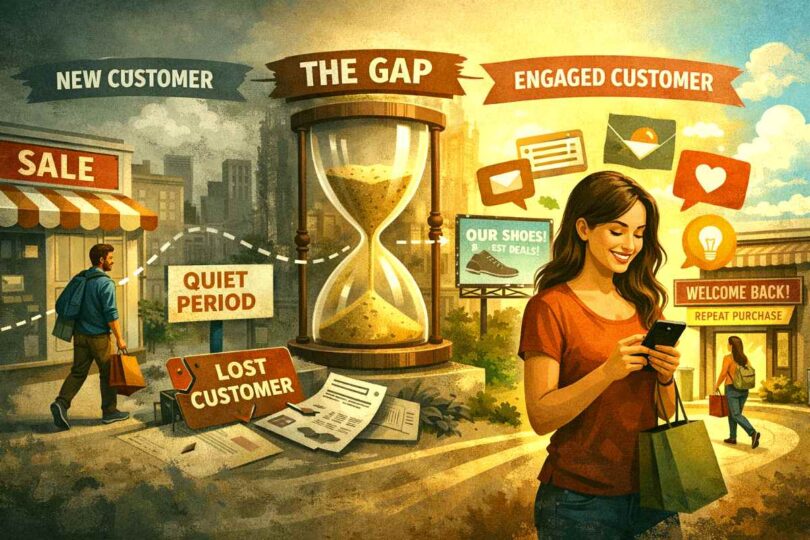

The most difficult part of running a business is not the initial sale. It’s maintaining relevance with customers between purchases—and failing to do so means that businesses that successfully acquire new buyers often wonder why their existing ones never come back. It’s because those businesses use all of their resources to acquire new customers without considering the time it takes for the average customer to need something again.
It’s during this gap that businesses either lose customer interest or maintain their loyalty. Those that figure out what to do in between purchases learn to acquire and retain customers who reliably contribute to bottom lines. Those that fail spend time and money continuously seeking new buyers for much higher acquisition costs.
Why the Gap Between Purchases Is More Important Than People Think
When customers buy something from a business, they essentially enter a moment of peak engagement. They seek out a service or product, they’re excited to make the purchase, they’re paying attention to what they need, and they operate as an engaged consumer. Then the product arrives, they use it, and life goes on. Unless intentional touchpoints are made in between, people forget about the company.
This only becomes worse when companies attempt to engage with these same customers’ competitor products. For example, a person may buy a new pair of running shoes, but three months down the line, they should probably get another pair (or at least another color). But if the competitor has been marketing like crazy in the past three months and your business has been quiet, that repeat purchase probably isn’t coming back to you. Visibility and awareness during consideration stages matter just as much as when people decide to buy.
Growing businesses realize this and create systems to remain on top of minds while not being annoying. There’s a fine line between too much attention and needed attention but no business can afford to ignore this process.
How Retention-Focused Businesses Bring Value in Addition to Another Sale
The businesses that manage retention well don’t send out annoying marketing emails begging them to purchase yet again. They supply value. This could be valued in the form of additional content that relates to what they already have purchased, or in some cases, guidance for appreciating what they have for as long as possible—or something related entirely.
For example, a business that sells coffee-related equipment might reach out later with brewing techniques or maintenance ideas for the machines. A business that sells clothing might reach out later with clothing care tips on how to keep things new. This way, the value received from the previous purchase comes from something in the meantime between purchasing stages and allows businesses to remain relevant. It also helps customers get what they need out of their investments.
When this interaction does not rely on sales but instead value acquisition, the buyer welcomes the message instead of ignoring it. It reinforces goodwill that helps with future purchases since they naturally happen instead of being retargeted through aggressive marketing.
How and Where Communication Succeeds
Email is a viable channel for this type of engaged selling because it allows for long-form messaging but as time goes on, open rates continue to plummet as inboxes become increasingly full. It’s more effective for a business to reach out across multiple touchpoints so buyers can be consistently aware without being overwhelmed.
A mobile solution has become essential: where people spend most of their time looking down at their phones, businesses should have opportunities to engage at that same eye level with appropriate content.
Working with a push notification mobile ad network offers businesses a way to reach customers directly on their phones without relying on email open rates or social media algorithms. Push notifications appear on devices when customers are already active, creating timely touchpoints that feel more immediate than emails sitting unread in crowded inboxes, and when used thoughtfully, they keep businesses visible during the periods between purchases without overwhelming recipients.
Ultimately, any avenue for communication relies on frequency and timing. Too much and people unsubscribe—or worse—ignore everything. Too little and the business gets forgotten about altogether. Finding that sweet spot relies on purchase cycles, customer desires and depends upon what value is actually brought to the situation.
When Timing Works
The best thing a business can avoid is a one size fits all newsletter once a month per customer. Smarter businesses time outreach based on purchase history and individual experience—for example, someone who bought winter clothing in November likely isn’t ready to purchase from that same business again until next fall—but they might appreciate content related to garment care in spring.
For items that clearly need replacements, outreach can be timed based on how long it usually takes customers to go through such products before needing more. Coffee subscriptions, dog food supplies and deodorants have natural replacement windows; reaching out either before or just about when people need more is incredibly welcomed.
For items that don’t have such circled purchase dates, engagement becomes necessary—if someone hasn’t opened an email in weeks or months, a re-engagement campaign could encourage someone back with an offer. If they’ve been clicking and reading all along, they’re likely primed for an opportunity.
Systems That Grow
Small businesses can keep track of customers manually, ensuring each one has an effective personal experience with potential outreach. Once companies grow larger, this becomes impossible without systems created over time. Businesses that learn to scale successfully develop automated sequences that trigger touch points all along without manual retention efforts minute by minute.
This doesn’t mean generic emails with “Dear Firstname.” It means thoughtful appreciation sequences based on what they’ve purchased, when they’ve purchased, and their engagement along the way so far. Good automation should feel personal instead of plugged in although it runs on autopilot consistently.
The investment pays off when lifetime customer value increases per buyer—sometimes one purchase generates $50—but when engaged remains well over $500 across multiple years for multiple purchases. This is only determined based on what happens during the time in between purchases.
Retention doesn’t have to be expensive or involve teams dedicated solely to retention efforts. It requires deliberate thinking about what happens post-sale and how to keep touch points valuable during the interim periods in between purchases; those who do this successfully are the ones who achieve sustainable growth instead of constantly fighting for new buyers.