


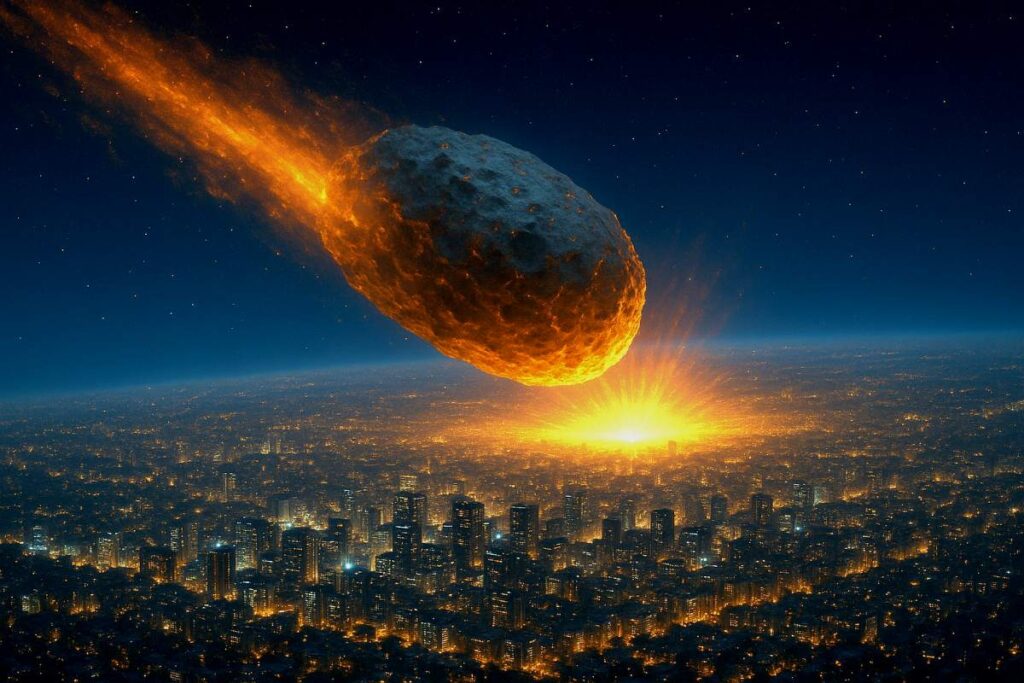
Are people right to worry that a giant asteroid could one day bring life on Earth to an end? The concern resurfaces with every close approach of a near-Earth object. While scientists emphasize that civilization-ending impacts are extremely rare, the mix of biblical prophecy and modern astronomy has kept the name “Wormwood” alive in public imagination.
The Biblical Roots
Wormwood comes from the Book of Revelation, where it is described as a great star falling from heaven, turning a third of the waters bitter, and causing widespread death. For many, this passage is symbolic. For others, it has become intertwined with modern fears about asteroids and comets capable of reshaping life on Earth.
The imagery of a fiery star crashing into Earth’s surface aligns eerily with what scientists now know about large asteroid impacts: extreme heat on entry, global fires from debris, shockwaves racing across continents, and poisonous particles thrown into the atmosphere and oceans. What was once prophecy is now recognizable as a possible, though rare, scientific event.
Asteroids Under Watch
NASA and international space agencies currently track more than 34,000 near-Earth objects (NEOs), with a few hundred considered large enough to cause regional or global damage. These range from small rocks the size of buses to massive bodies that could devastate the planet if they struck.
Among them, Apophis drew global attention when early calculations suggested it might collide with Earth in 2029 or 2036. Updated models have since ruled out those impacts, though the asteroid will pass within 20,000 miles of Earth in 2029, closer than many communications satellites. The flyby will be visible to the naked eye in some regions, and while scientists say it poses no danger, its near-miss underscores Earth’s vulnerability.
Other objects remain under watch. Asteroid Bennu, about 1,600 feet in diameter, has a very small chance, roughly 1 in 1,750, of hitting Earth between 2175 and 2199. That probability is low, but still significant enough for NASA to classify Bennu as one of the two most hazardous asteroids currently known.
What Would an Impact Do?
The damage depends entirely on the size and speed of the object. Small asteroids, which strike Earth’s atmosphere regularly, usually burn up as fireballs. Medium-sized impacts, like the 2013 Chelyabinsk event in Russia, can still injure hundreds through shockwaves and shattered glass.
But if something on the scale of Apophis or Bennu struck Earth, the consequences would be catastrophic. A direct land impact could flatten cities, ignite wildfires, and create shockwaves capable of leveling everything for hundreds of miles. An ocean impact would launch mega-tsunamis that could devastate coastlines across entire regions.
A much larger body, several miles wide, would mirror the event believed to have ended the dinosaurs 66 million years ago. The combination of impact force, debris in the atmosphere, and resulting “impact winter” would collapse agriculture, cool global temperatures, and potentially lead to mass extinction. In such a scenario, it would indeed be “game over” for modern civilization.
What Science Can and Cannot Do
In 2022, NASA’s DART mission demonstrated that a spacecraft could alter the path of a small asteroid. The experiment was hailed as a milestone in planetary defense, showing that with enough warning, humanity could theoretically nudge an asteroid off course.
But scientists are candid about the limitations. Deflection requires decades of advance notice. A large object discovered on short notice, say, within a few years of impact, would leave little or no time to prepare. Current technology could not prevent a collision of that scale. Even medium-sized bodies could slip past undetected, as happened in 2019 when a football-field-sized asteroid flew within 45,000 miles of Earth, only hours after astronomers first spotted it.
Why Wormwood Still Resonates
The persistence of Wormwood in both faith and science reflects a shared truth: Earth is vulnerable. For some, Wormwood symbolizes divine judgment. For scientists, it represents a real, though statistically rare, danger from space.
The likelihood of a civilization-ending asteroid striking in our lifetimes is extremely low, NASA estimates a chance of less than 0.01% for the next century. Yet the fact that such events have happened in Earth’s past means they could happen again. Between the prophetic imagery of scripture and the hard data of astronomy lies the same uneasy truth: one day, whether in a thousand years or a million, humanity may face the kind of cosmic threat that leaves no margin for error.