


The rise of artificial intelligence has stirred fascination and concern across nearly every industry, and plastic surgery is no exception. As AI continues to reshape how medicine is practiced, many remain skeptical of its growing influence. But behind the scenes, AI is quietly becoming an indispensable tool in the hands of skilled surgeons, delivering more precision, better outcomes, and a safer overall experience for patients.
“AI is being used a lot now in plastic surgery, and it’s not going away,” says Dr. Brandon Richland, a board-certified plastic surgeon with practices in Southern California and Las Vegas. “We’ve been able to harness these tools to improve patient experiences and outcomes, and that’s what matters most.”
Concerns around artificial intelligence are understandable. A 2024 study published in Frontiers in Psychiatry explored why many people experience what researchers call “existential anxiety” when faced with the idea of AI. That unease stems from worries about unpredictability, ethical boundaries, and fears that human connection might be lost in a future dominated by machines. But the study also suggests that much of this anxiety comes from unfamiliarity, and that once people understand how AI is actually being used, the fear often diminishes.
In plastic surgery, AI is not a looming threat to human judgment. Instead, it’s a set of tools helping surgeons deliver smarter, safer, and more personalized care. The U.S. Department of Veterans Affairs reports that AI is rapidly transforming surgical practices by enhancing precision, reducing errors, and improving patient safety across the board. From helping patients visualize surgical outcomes to guiding robotic arms in the operating room, AI is playing a crucial role in elevating care.
How AI is Changing the Game in Plastic Surgery
Consultation and Planning
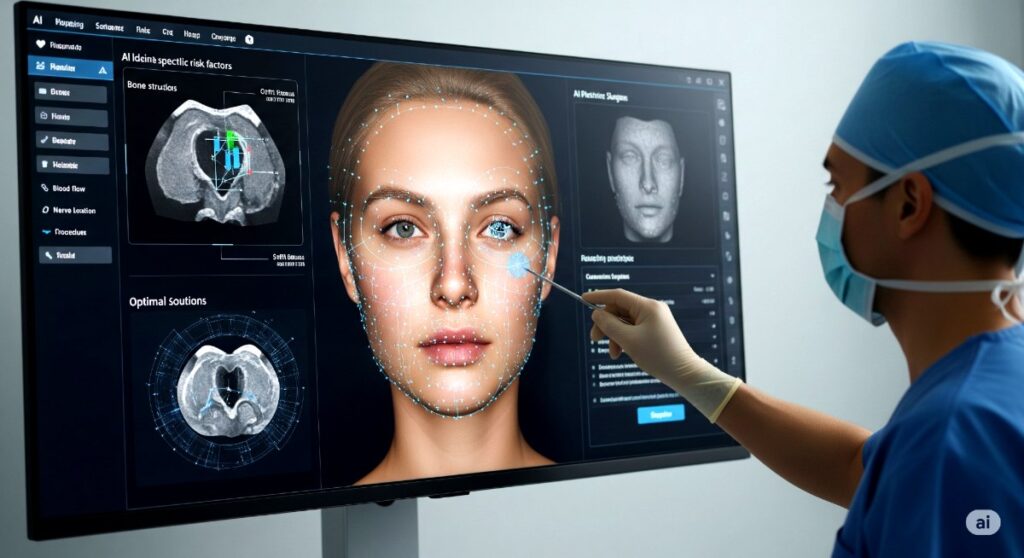
One of AI’s most impactful uses comes before any surgery begins. Today’s AI-powered imaging systems allow patients to preview highly realistic simulations of their potential results. These simulations are created using each patient’s unique body data, giving them a clearer sense of what to expect, and helping to build trust between patient and surgeon. AI also assists behind the scenes by analyzing facial and body structures to suggest optimal surgical approaches.
Surgical Precision in the Operating Room
Inside the OR, AI-guided robotic systems are assisting with complex procedures that demand extraordinary precision. These systems can stabilize movements beyond what human hands can achieve, which is especially valuable in microsurgical tasks such as breast reconstruction. AI also helps map a patient’s anatomy, guiding surgeons to avoid sensitive structures like blood vessels and nerves, reducing the risk of complications and improving outcomes.
Post-Operative Monitoring and Recovery
The role of AI doesn’t end after the procedure. Wearable sensors powered by AI are now being used to monitor patients during recovery, capturing real-time data and flagging early signs of infection or delayed healing. That means quicker interventions and smoother recoveries. At the same time, AI is gathering valuable insights from each procedure, helping surgeons refine their techniques and continually improve outcomes for future patients.
More Accurate Diagnostics
AI systems are also being used to analyze massive libraries of medical images, detecting subtle signs of complications or abnormalities that might be missed by the human eye. This can lead to earlier diagnoses, better treatment planning, and overall improved patient care.
“While there may be a few concerns with AI, the benefits that it provides significantly outweigh them,” says Dr. Richland. “Being able to provide our patients with a higher level of care because of AI is a win-win for everyone, and we’re excited about it.”
That said, challenges remain. Ensuring data privacy, addressing algorithmic bias, and maintaining the human connection between doctor and patient are critical concerns. There’s also the question of accountability: If something goes wrong, who’s responsible, the surgeon or the algorithm?
A 2024 report in the Journal of Plastic, Reconstructive & Aesthetic Surgery concluded that while these challenges are real, they are not insurmountable. The key, researchers wrote, is collaboration. With proper oversight, transparency, and continued development, AI can help usher in a new era of medicine, one where humans and machines work together to deliver optimal care.
Dr. Brandon Richland
Dr. Brandon Richland is a board-certified plastic surgeon known for his commitment to natural-looking results and exceptional patient care. With practices in Newport Beach, Fountain Valley, Woodland Hills, and Las Vegas, and a Dallas location coming soon, he offers a full range of surgical and non-surgical treatments tailored to each patient’s goals.
He specializes in transformative mommy makeovers, including breast augmentation, lifts, reductions, tummy tucks, skin tightening, and body contouring. His advanced facial procedures include facelifts, chin liposuction, and fat transfers. For those seeking non-invasive treatments, Dr. Richland also provides luxury services like red carpet-ready Forma facials. He is a graduate of UCLA and the Saint Louis University School of Medicine, where he earned the prestigious Top Surgery Student award.
To learn more, explore services, or view before-and-after photos, visit www.RichlandMD.com or follow @Dr.Richland and @RichlandAesthetics on Instagram.
Sources:
- Frontiers in Psychiatry, “Existential anxiety about artificial intelligence (AI),” April 2024
- U.S. Department of Veterans Affairs, “AI Revolutionizes Surgical Precision and Patient Outcomes at Tampa VA,” March 2025
- Journal of Plastic, Reconstructive & Aesthetic Surgery, “Artificial intelligence in plastic surgery: Where do we stand?” September 2024