

 There’s nothing like a good conspiracy theory. Mystery, intrigue, cover-up, disappearing witnesses, vows of silence, anonymous tipsters, a trail of clues, shadowy, menacing authority figures – all of these elements form the backbone of every conspiracy from the DaVinci Code up to the JFK assassination and beyond. The formula is basically the same: take a largely unexplained event or phenomenon, dissect its circumstances in order to point out flaws in the logic behind the official explanation, present an alternate explanation (often fantastic or at the very least, far sexier than the cover story,) and then illustrate the ways in which the powers behind the official explanation have subverted the truth. It gets me every time, from Tupac-is-still-alive theory to the old we-never-landed-on-the-Moon bit. Conspiracy theories tap into the sensation that a secret, no matter how provable it may be, is inherently cool. Who wouldn’t want to be in on a secret, particularly when within that secret is the answer to one of the all-time greatest questions of mankind – are we alone in the universe?
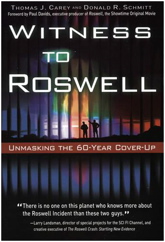
Authors Thomas J. Carey and Donald R. Schmitt believe that the answer to that question lies in a 1947 UFO crash near Roswell, New Mexico that has come to be known as the Roswell Incident. In their new book, Witness to Roswell, Carey and Schmitt present 60 years of compiled evidence to make the case that on July 3, 1947, an alien spacecraft went down over the New Mexico desert, leaving a debris field several hundred yards long and an even longer line of witnesses. These include: Mack Brazel, the simple rancher on whose property the vehicle crashed and the man who brought it to the attention of the U.S. Air Force by fragments of wreckage in a cardboard box; citizens of New Mexico who poured into the area from all over the state, lured by stories of a crashed flying saucer and an alien encounter; and scores of military personnel brought in to secure the site, which not only included cleanup of the debris, but also covert shipping of the discovered craft and the bodies of its extraterrestrial pilots as well as the intimidation of potential witnesses to the incident.
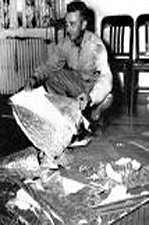 In this book, the authors apply the conspiracy formula step-by-step, methodically deconstructing the official explanation while piecing together evidence to support their own conclusions. First they address the official explanation. The U.S. military has maintained that while an airborne vehicle did crash in New Mexico in early July of 1947, it was not a piloted vehicle at all, and certainly not a UFO. Rather, it was a weather balloon routinely deployed as part of a project called Operation Mogul. The authors point out several glaring flaws in this explanation, but perhaps the most damning is the fact that the first official reports of the incident, which came from the Roswell Army Air Field itself, indicated that a “flying saucer” had been recovered. It was not until several hours later, after higher authorities had assumed control of the matter, that the weather balloon story was disseminated and the initial “flying saucer” report discredited. Why the two reports?
Casey and Schmitt also attack the veracity of the weather balloon story itself. If the object was merely a weather balloon, why the need for such extreme secrecy and security measures enacted at the crash site, including armed guards, riflemen, and military police? Why was Mack Brazel detained for four days and subjected to intimidation and interrogation while cleanup operations were taking place on his ranch? Why was he given an armed military escort to media outlets such as The Roswell Daily Record and radio stations KGFL and KSWS to retract his initial claim of discovering a flying saucer? Finally – if whatever it is that crashed was part of a military operation, why weren’t they looking for it in the first place? Why did Mack Brazel have to drive 75 miles in order to bring them pieces of debris?
 This is merely the surface of the case that Casey and Schmitt bring to life over two hundred pages of interviews, both with firsthand witnesses and in the case of people who have died, secondary interviews with relatives. Both authors are dedicated UFO researchers who have lent their expertise to the SciFi Channel’s documentary on the Roswell Incident, as well as devoting many years to compiling the stories presented in this book. They are remarkably thorough in pursuing anyone and everyone with a story to tell about the incident, and freely admit how difficult it has been to locate living witnesses. In many cases, once they were able to track down someone who had seen something firsthand, that person would prove to be unwilling to talk for fear of intimidation even sixty years later.
Unfortunately, this reliance on interviews (some of which are secondhand stories) often undermines the overall effectiveness of their argument. Recollections of 80-year-old men are not necessarily airtight, to say the least – and the motivations of secondhand witnesses are unclear. The bottom line is that in the case of this conspiracy, while the circumstantial evidence is strong, the direct evidence is scant. For example, the authors argue repeatedly that in the days before the Army arrived at Brazel’s ranch to secure the site, people from all over the state flocked to the area and combed through the debris field recovering pieces of what is known as the “Holy Grail of Roswell.” These, of course, are pieces of the craft itself, referred to as memory metal. Witnesses describe small fragments of a thin metal about the consistency of aluminum, lightweight yet strong, but with a fantastic ability to be manipulated into any shape before snapping back into its original form. Casey and Schmitt provide numerous accounts of eyewitnesses performing homemade tests on this material, including contorting it, holding it to a flame, even shooting it with rifles, and in each case the metal proved indestructible. If this is true, and this remarkable technology exists, why hasn’t a single piece of this material surfaced in the past sixty years?
The nature of conspiracy theories doesn’t allow all of the potential questions to be answered – that’s the beauty of a good theory – but Witness to Roswell does an admirable job of highlighting the points of discussion and provoking thought. So what was it that crashed out there in the desert on that night in 1947? We may never know the whole truth, but it sure is fun to ponder the possibilities.
Witness to Roswell: Unmasking the 60-year-old Cover-up, New Page Books (a division of Career Press) www.newpagebooks.com